


Most organizations are sitting on emissions data they don’t fully understand. It exists in fragments, collected by individual assets, reported for different purposes, and rarely connected in a way that provides a clear picture of what’s happening across the business.
The real value comes when organizations move beyond collection and compliance, and start using emissions data to understand operational performance, identify where risks exist, and uncover opportunities to improve.
The Risks of Fragmented Emissions Data
Fragmented emissions data management creates real limitations. When data is fragmented, it removes context and limits the ability to develop interpreted data creating a barrier to performance optimization, whether across facilities, products, or time periods.
Without that context, it becomes difficult to identify opportunities with time to respond, see small problems before they are big problems, or evaluate exposure to risks like energy price volatility, water supply constraints or waste stream mismanagement.
Organizations are left asking questions such as:
- Why is this asset less profitable?
- Where are we most exposed to resource consumption inefficiency?
- What do wastewater emissions reveal about process improvement opportunities?
- Which products are most vulnerable to carbon-related costs?
Without a connected view of the data, these questions are difficult to answer.
What Emissions Data Reveals About Operational Efficiency
When organizations talk about emissions, they’re typically referring to low- or no-value operational by-products, this is what some might call externalities. Emissions includes wastewater, air emissions, or solid waste streams that need to be treated or managed.
But these by-products also provide insight into how efficiently an operation is running.
Any process by-product that does not support a business case is evidence that an input was either misallocated or not fully utilized. In that sense, emissions are an indicator of inefficiency.
How to Use Scope 1 and Scope 2 Emissions as Performance Indicators
Scope 1 and Scope 2 emissions, when expressed as an intensity, provide a way to evaluate performance in context. Scope 1 covers direct emissions from owned sources (fuel combustion, company vehicles), while Scope 2 covers purchased utilities.
Depending on the mix, this data can reveal several elements of operational performance and efficiency.
When emissions are normalized—per unit produced or per dollar of revenue for example—it becomes possible to compare assets more effectively. This helps identify underperforming or high-performing sites from a perspective that goes beyond cost and revenue alone. It gives you something to act on.
Using Emissions Visibility to Improve Resilience and Performance
One example is a global cement company operating a cluster of ready-mix plants in a region experiencing a multi-year drought. As water scarcity increased, local authorities required industrial users to cut back consumption, creating a risk that the company would need to reduce production.
To better understand their exposure, the company looked closely at their produce process end to end, including its wastewater emissions across operations. They also looked at wastewater outputs from other industrial users in the same watershed.
Based on the volume and composition of that wastewater, they determined they didn’t actually need fresh water for their process. They were able to modify operations to use reclaimed water, from both their own sites and neighboring facilities.
As a result, they avoided production cutbacks, reduced reliance on freshwater, and applied the same approach across global operations facing similar constraints.
Why Stakeholders Demand Auditable and Traceable Emissions Data
Expectations around emissions data are continuing to evolve.
Organizations are now collecting data from a different perspective. It is no longer limited to submitting reports or ensuring compliance at the asset level. Regulators, investors, and customers want to understand risk and impact at multiple levels, from a corporate, product, and asset level.
It’s also no longer enough to say the data is accurate. Stakeholders expect defensible data, adherence to accepted standards, and in many cases third-party verification to confirm that data is being collected and processed appropriately.
This is an area where Cority has recently been recognized for innovation. Cority’s Next-Gen Emissions Calculation Management Toolset was recognized at the 2026 Environment + Energy Leader Awards cority for helping organizations generate accurate, auditable, and decision-ready emissions data at scale, including access to a large emissions factor library, flexible methodology management, and audit dashboards that provide detailed visibility into data sources and calculation logic.
How to Achieve Enterprise-Wide Emissions Data Management
To fully assess risk and exposure, and identify opportunities organizations need both a bottom-up and top-down view of their data.
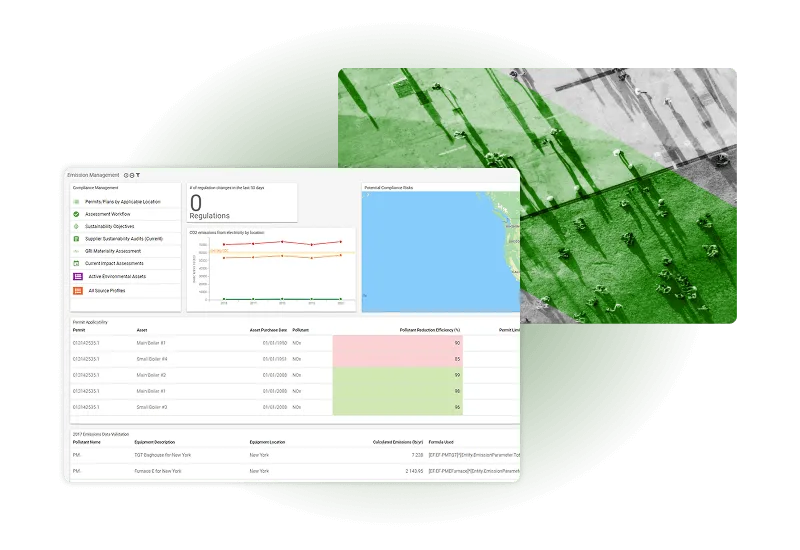
That means understanding individual asset performance while also placing it in the context of enterprise-wide trends, peer comparisons, operational processes and regional constraints. Achieving this requires an integrated approach to emissions data management.
Organizations need to clearly communicate the value of emissions data across the business. Everyone involved, from plant-level specialists to corporate decision-makers, needs to understand what’s at stake.
Consistency in data collection and processing is also critical. Without it, comparisons lose meaning.
Technology plays a role, but it’s only part of the solution. It can support automation, collaboration, analysis and consistent collection, but it needs to be supported by the right processes and cultural alignment across the organization.
Common Challenges in Improving Emissions Visibility
There are a few common obstacles organizations tend to encounter.
- One is treating emissions as a compliance-only exercise, which limits how the data is used.
- Another is not treating data as a shared asset. When data is siloed, its value is reduced.
- A third is not clearly understanding the relationship between emissions data and operational sustainability, making it harder to act on insights.
Turning Emissions Data into Decision-Grade Intelligence
Having access to interpreted data, not just numbers, but data that’s turned into information, changes how organizations operate.
When you combine things like consumption and outflows, production, and asset-specific risks like climate exposure, and layer all of that together, you can compare performance across the enterprise. That gives leaders information they really can’t get anywhere else.
It allows them to see patterns, identify differences across assets, notice seasonal and regional variations and make more informed decisions based on a more complete view of the business.
When organizations combine local control with enterprise-level context, supported by automation, supplemented by analytics, and interpreted by people, they gain a clearer understanding of both risk and performance.
This provides decision-grade intelligence and helps identify opportunities to build resilience and operationalize sustainability.
When emissions data management is approached this way, it stops being a reporting obligation and becomes one of the most valuable inputs an organization has, for managing risk, improving performance, and making decisions with confidence.

