The best EHS software is not the one with the longest feature list. It is the one that lets an organization consolidate environmental, health, and safety into a single operational system.
The 2026 Gartner Market Guide for EHS Software makes the same point in its maturity model, ranking a unified EHS management platform as a more advanced stage than a collection of single-purpose modules.
That reframing matters because most comparison guides rank vendors as if every buyer wants the same thing. They do not. The right platform depends on the size of the organization, the complexity of its operations, and how far along it is in its EHS journey.
This guide draws on the 2026 Gartner Market Guide for EHS Software, buyer research across the mid-market and enterprise, and a five-lens evaluation framework. Rather than crown a single winner, it routes each reader to the platforms that fit their profile. Find the buyer type below that matches the situation, then jump to the section that covers it.
If this sounds like the organization | Start here | Platforms to compare |
|---|---|---|
EHS & Risk Leader: Director or VP of EHS at a multi-site industrial organization in manufacturing, oil and gas, utilities, or mining, focused on reducing incidents and standardizing across sites | Cority is built for this profile | |
Strategic Transformation Owner: VP of EHS, Operations, or Sustainability at a large enterprise consolidating EHS and ESG under executive-level reporting | ||
Entry-Point Operator: EHS Specialist, Safety Coordinator, or Sustainability Manager at a single-site or smaller organization solving one specific, immediate problem | Begin with a focused tool, then plan to consolidate | StarTex (EHS Insight), EcoOnline, or Evotix; SafetyCulture for mobile-first inspections, Field1st for frontline crews |
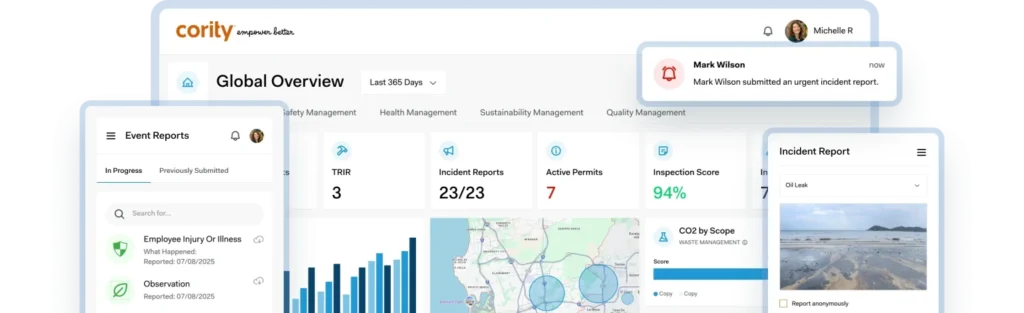
What makes the best EHS software in 2026?
Every EHS platform looks capable in a feature list. Incident management, audits and inspections, training records, corrective actions. These appear on nearly every vendor’s website because the core of EHS software has been stable for years. But a checklist of features tells a buyer almost nothing about which platform is best for their organization.
What separates platforms is whether they help an EHS program mature. The 2026 Gartner Market Guide for EHS Software describes this as a progression:
- organizations move from paper and spreadsheets,
- to digitizing one module at a time,
- to a single unified EHS management platform,
- and eventually to advanced technologies like predictive analytics and computer vision.
The inflection point in that journey is consolidation: the move from scattered tools to one connected system.
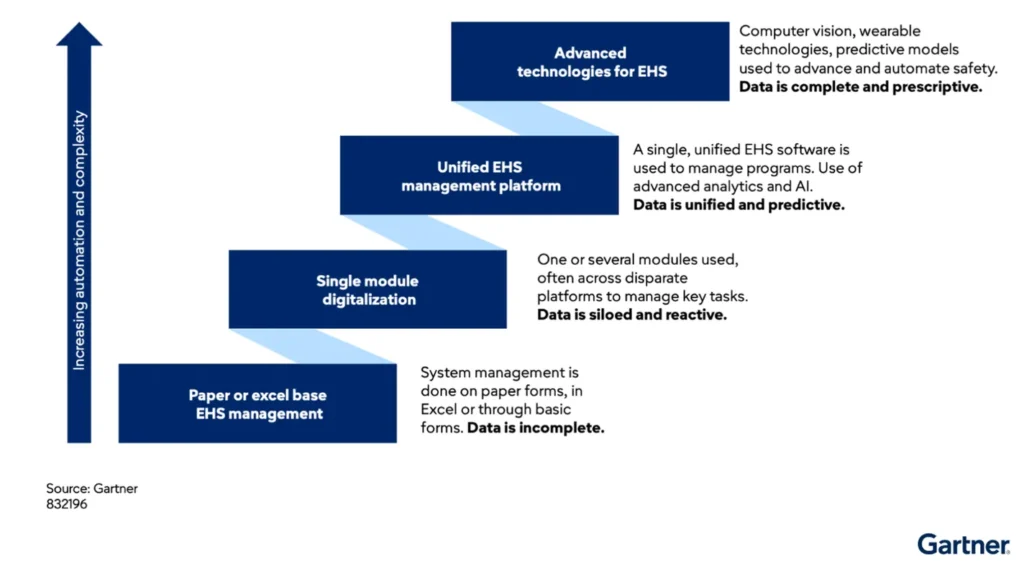
Gartner frames the market the same way when it separates core capabilities from differentiating ones. Data collection, analysis, regulatory reporting, and program management are table stakes that nearly every vendor offers.
The real differentiators are integration, configurability, AI, and scalability paired with domain expertise. Those are the capabilities that determine whether a platform can actually consolidate an EHS program or simply digitize pieces of it.
This is where the market divides into categories, and where most buying mistakes happen.
- Point solutions go deep on one topic but cannot connect the rest of the program.
- Horizontal business platforms can technically host EHS modules, but their workflows are not built around how EHS actually operates.
- Custom-built and legacy systems may fit today but rarely scale or evolve with new regulations.
Only a unified EHS platform with genuine domain expertise consolidates the full program on one data backbone.
The reason consolidation matters is that EHS work does not happen in isolation. An audit finding should trigger a corrective action. A near-miss should feed the next risk assessment. An industrial hygiene exposure should flow into occupational health surveillance, risk assessments, and corrective actions.
When these workflows live in disconnected tools, those connections never form, the data never tells a complete story, and the organization is left reacting to incidents instead of preventing them.
The strongest EHS platform, then, is the one that turns separate programs into a single system. The next section covers where one vendor fits that test, and where it does not.
Where Cority fits, and where it does not
Cority builds solutions for organizations that understand EHS is not a box-checking exercise, but a strategic choice. It serves multi-site and global operations, regulated industries, and programs spanning safety, occupational health, industrial hygiene, environmental compliance, and sustainability on one platform.
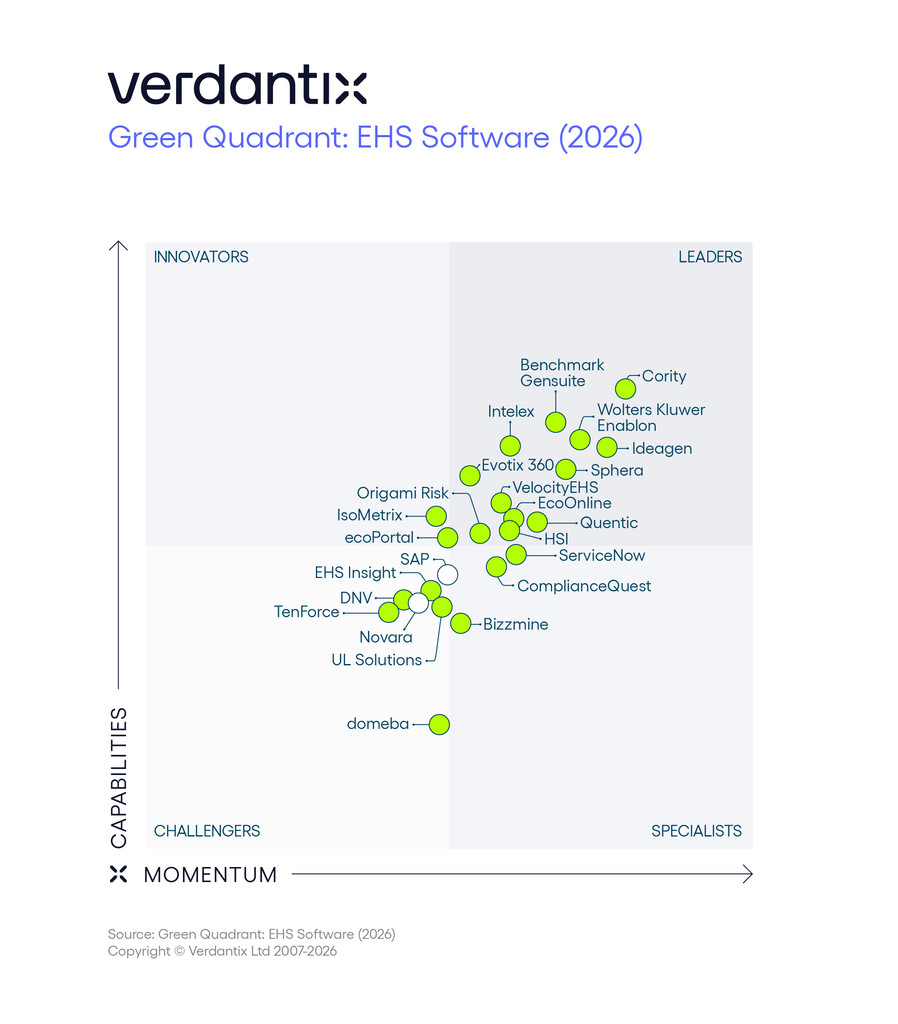
Cority is positioned as a Leader in the Verdantix Green Quadrant: EHS Software (2026).
The breadth in functionality is deliberate. Mature EHS programs eventually hit the ceiling of point solutions (separate tools for incidents, health surveillance, and environmental reporting that do not share data). Cority exists either to be the platform these organizations graduate to, or to eliminate the need for those separate systems in the first place.
However, while Cority is designed to meet organizations where they are today and grow with them, those managing straightforward compliance for a small number of sites may find a lighter tool is all that is required.
Cority also brings deep functional expertise in specific areas.
- First, occupational health and industrial hygiene: Cority delivers clinical-grade capabilities in a category where many vendors offer little beyond basic case tracking.
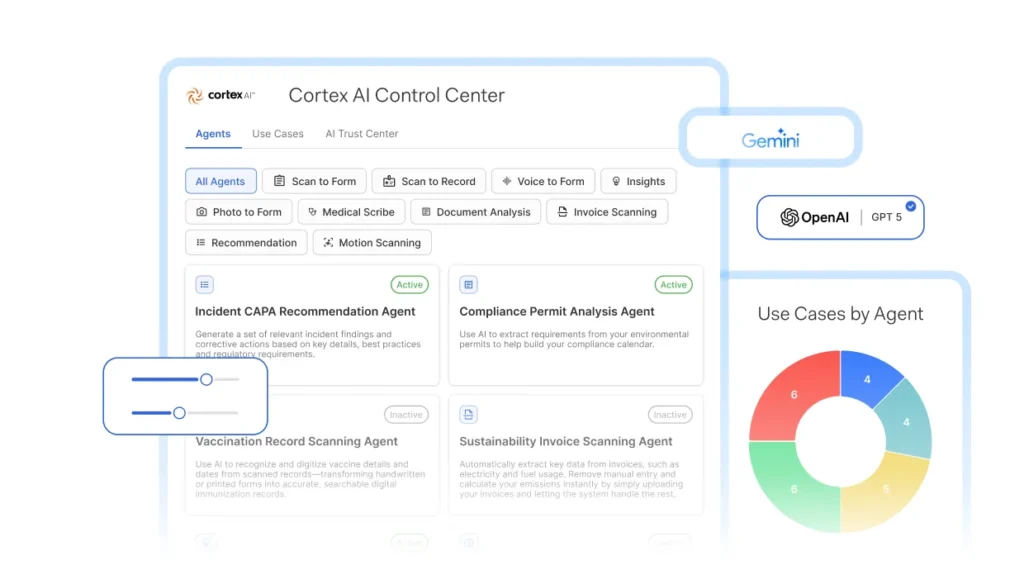
- Second, AI agents built specifically for EHS that sit inside the workflow: Cortex AI embeds agentic capabilities, including CAPA recommendations and environmental permit analysis, directly into EHS processes, rather than adding a general-purpose chatbot alongside them.
- Finally, Cority is a hyper-configurable no-code platform, which is essential for organizations whose workflows do not fit a template. It also means deployment is a design exercise, not an install.
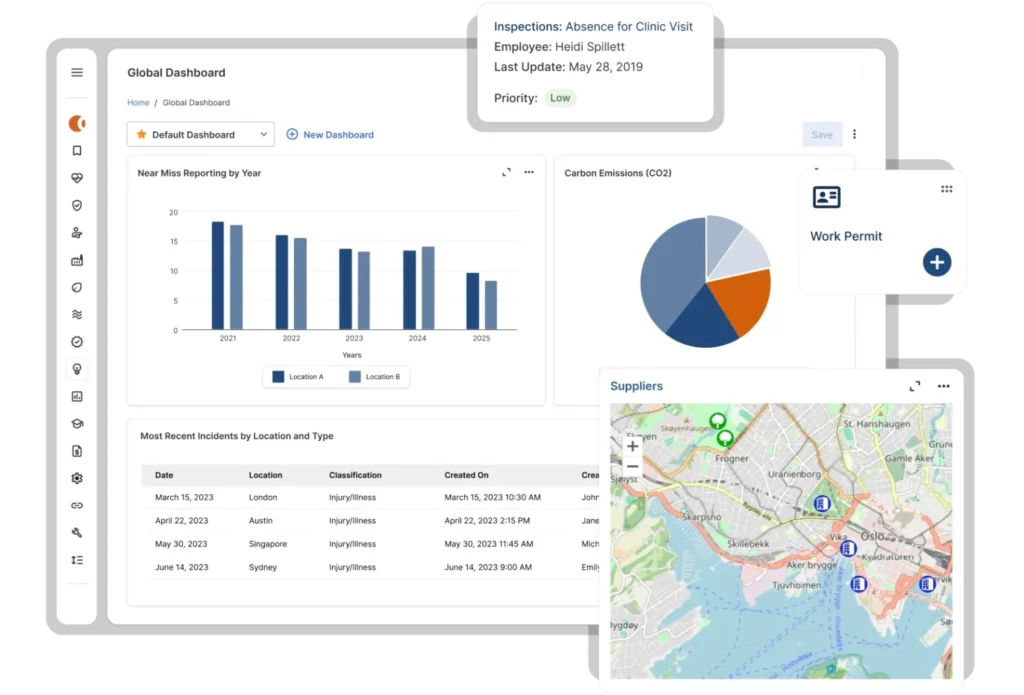
The organizations that get the most from Cority come in with clear requirements and treat implementation as program-building. Every EHS platform requires some configuration. The real question is what happens after go-live. Buyers who only need a simple tool for today’s requirements may be served by a lighter product — but they should expect it to stay static while their program grows.
How to evaluate EHS software: the 5-lens framework
Feature checklists fail because they measure what a platform has, not what it can do for a program. A better evaluation looks at the capabilities that actually separate vendors. Building on the differentiating capabilities Gartner identifies in its 2026 Market Guide, the following five lenses turn that idea into five practical questions a buyer can ask of any platform.
Lens | The real question to ask |
|---|---|
1. Topic breadth across EHS | Does the platform support environmental, health, and safety with comparable depth, or is one pillar bolted on? |
2. Domain expertise | Was the platform purpose-built for EHS workflows, or are EHS modules grafted onto a general business platform? |
3. Configurability without IT | When regulations or processes change, can the EHS team adapt the platform, or does every change require an IT ticket? |
4. AI grounded in EHS workflows | Does the AI understand EHS context, including regulatory citations, hazard taxonomies, and exposure thresholds, or is it a generic model bolted onto the interface? |
5. Scalability across complex operations | Can the platform deploy consistently across multiple sites and regions, with the language, regulatory, and operational variation that comes with them? |
Topic breadth across EHS
Most platforms are strong in one pillar and thinner in the others, and a standard demo only shows the strong one. Gartner’s vendor analysis found health topics, including medical surveillance and occupational health, to be the most inconsistently covered area in the market. The test is whether all three pillars share one data model, so a finding in one area can flow into another.
Domain expertise
A platform built for EHS reflects how practitioners actually work, while a general business platform with added EHS modules often does not. The difference surfaces in EHS-specific concepts: serious injury and fatality analysis, permit-to-work, hierarchy of controls. If those ideas are native to the system rather than custom-built, the platform was designed for EHS.
Configurability without IT
Regulations and processes change constantly, and an EHS team that cannot adapt its own platform will build workarounds outside the system. The question is whether a user can add a field, adjust a workflow, or respond to a new requirement without writing code. Configurable platforms keep pace; rigid ones accumulate shadow processes that undermine data quality.
AI grounded in EHS workflows
Nearly every vendor now claims AI, so the distinction is whether the AI is trained on EHS context or simply wrapped around a general model. Gartner notes that all surveyed vendors maintain human-in-the-loop oversight, so the real variation is in which use cases are actually available and how well they understand EHS data. Strong AI identifies hazards, recommends corrective actions, and traces its reasoning to a source.
Scalability across complex operations
A platform that works at one site can still struggle across twenty in different countries. Scale introduces variation in language, regulation, and local process that a smaller deployment never exposes. The test is whether the platform holds up under that complexity without fragmenting into site-by-site versions.
Best EHS software in 2026: Cority compared to the top alternatives
The platforms below represent the strongest alternatives a buyer is likely to evaluate, drawn from the representative vendors in the 2026 Gartner Market Guide for EHS Software. Each fits a different buyer profile. Organizations whose only immediate need is mobile-first frontline inspection logging may also consider SafetyCulture, which Gartner classifies outside the EHS software market as a workplace operations platform.
Platform | Best for | Core strength | Typical gap vs. Cority | Primary customer size | Deployment time |
|---|---|---|---|---|---|
Operational Risk Leader and Strategic Transformation Owner | Unified EHS, sustainability and ESG, and quality with deep occupational health and Cortex AI | Reference platform | Mid to large enterprise | 12 to 42 weeks | |
Operational Risk Leader | Industrial ergonomics, usable mobile experience | Lighter occupational health depth; narrower EHS, ESG, and quality breadth | Mid-market to enterprise | 20 to 25 days; 6+ months for complex | |
Operational Risk Leader | Connected worker, AI agents for compliance | Unified but not easily configurable; system changes route through IT, which limits scalability | Mid to large enterprise | 8 to 16 weeks (technical set-up focused) | |
Entry-Point Operator | Chemical safety, fast time to value, EMEA reach | Thinner occupational health; narrower unified platform | Small to mid-market | 2 to 12 weeks | |
Entry-Point Operator | Employee-led safety culture, fast onboarding | Thinner health and environmental depth; smaller enterprise footprint | Mid-market | 3 to 6 months | |
Strategic Transformation Owner, Operational Risk Leader | Operational risk depth, IoT and automation | Less integrated occupational health; longer implementation | Large enterprise | 2 to 12 months | |
Enablon (Wolters Kluwer) | Strategic Transformation Owner, Operational Risk Leader | EHS, operational risk, sustainability and ESG | Partner-dependent implementation; steeper learning curve; fewer generally available AI use cases | Large enterprise | 3 to 12 months initial rollout |
StarTex (EHS Insight) | Entry-Point Operator | Self-onboarding, fast deployment | Not built for multi-topic enterprise consolidation | Small to mid-market | 30 days to 9 months |
VelocityEHS
VelocityEHS is a provider of environmental, safety, and risk technology with a reputation for a usable mobile experience. Its standout capability is industrial ergonomics, including sensorless motion capture, alongside AI features such as potential serious injury and fatality (PSIF) insights and confidence scoring for governance. Gartner reports rapid standard go-live times averaging 20 to 25 days, with complex deployments extending beyond six months.
Where it performs well is operational safety for mid-market and enterprise industrial organizations that value speed and frontline usability. Where it differs from Cority is in occupational health depth and the breadth of a unified EHS, ESG, and quality platform, both areas where Cority’s heritage runs deeper. For an Operational Risk Leader focused primarily on safety and ergonomics, VelocityEHS is a credible shortlist candidate.
Benchmark Gensuite
Benchmark Gensuite provides EHS, quality, sustainability, and risk management technology, and strengthened its connected-worker capability through the 2024 acquisition of Anvl. Its platform offers a mobile application with offline support and AI agents for permit and chemical compliance, with governance controls including audit logs, required human review, and traceability to source data. Gartner reports go-live times averaging 8 to 16 weeks, though those short timelines reflect technical set-up more than consultative implementation, so buyers should plan change management separately.
Where it performs well is connected frontline work and compliance automation for mid to large industrial enterprises. Where it differs from Cority is in configurability: system changes typically route through IT tickets rather than admin-level configuration, which can limit scalability as programs evolve. Benchmark Gensuite suits an Operational Risk Leader prioritizing connected-worker capability.
EcoOnline
EcoOnline provides EHS, ESG, chemical safety, contractor management, control of work, and training technology, and expanded through the 2023 acquisition of the Alcumus software division. Its clearest strength is chemical and materials management, where Gartner notes full adoption of AI, supported by strong EMEA presence and fast time to value of 2 to 12 weeks.
Where it performs well is chemical-intensive operations and organizations that want quick deployment. Where it differs from Cority is in occupational health depth and the breadth of a unified enterprise platform, where EcoOnline is comparatively lighter. For a smaller or mid-market organization with significant chemical safety needs, particularly in Europe, EcoOnline is a strong fit.
Evotix
Evotix provides safety, sustainability, and risk management technology with an emphasis on employee-led safety culture. Its platform offers a mobile application with offline capabilities, predictive tools, image analysis, and contractor document risk flagging, deployed through a preconfigured FastStart approach. Gartner reports go-live times of 3 to 6 months.
Where it performs well is engaging the frontline workforce in safety participation for mid-market organizations. Where it differs from Cority is in health and environmental depth and overall enterprise scale, where Evotix maintains a smaller footprint. Evotix suits a mid-market organization whose priority is building safety culture and frontline engagement rather than consolidating a full multi-topic program.
Sphera
Sphera, a Blackstone portfolio company, provides risk, compliance, and sustainability technology with notable operational risk depth. Its platform connects directly to IoT sensors and uses optical character recognition to automate data entry from inspections, governed by a zero-trust model with audit logs and configurable risk tolerance. Gartner reports implementation timelines of 2 to 12 months.
Where it performs well is operational risk and process safety for large industrial enterprises in sectors like oil and gas and chemicals. Where it differs from Cority is in integrated occupational health and in implementation speed, where Sphera’s timelines run longer. For a Strategic Transformation Owner or Operational Risk Leader focused on process safety at enterprise scale, Sphera is a serious contender.
Wolters Kluwer Enablon
Wolters Kluwer offers Enablon as part of a broad portfolio spanning compliance, legal, regulatory, and ESG software. Its EHS platform provides a mobile application with offline support, APIs to third-party systems, and AI use cases including system navigation and permit-to-work drafting. Gartner notes that implementations are partner-led, with initial global rollouts averaging around three months and full deployments commonly extending toward a year.
Where it performs well is enterprise-scale EHS, operational risk, and ESG-linked compliance for large, complex organizations with mature IT functions. Where it differs from Cority is in implementation model, since the partner-led approach and breadth of the platform can mean a steeper learning curve. Wolters Kluwer suits a Strategic Transformation Owner with strong internal IT.
StarTex (EHS Insight)
EHS Insight, a StarTex Software brand, provides safety, risk, and compliance technology built for fast, guided self-onboarding. Its platform offers a mobile application with offline capabilities, multiple AI features, universal audit trails, and configurable risk thresholds. Gartner reports go-live times ranging from 30 days to 9 months depending on scope.
Where it performs well is giving smaller and single-site organizations a fast, accessible entry point into digital EHS. Where it differs from Cority is in multi-topic enterprise consolidation, which is not the platform’s design intent. For an Entry-Point Operator solving a specific immediate problem, EHS Insight is a sensible starting point, with consolidation onto a unified platform as a later step.
The demo script: what to ask EHS vendors during a demo
Every vendor demo is designed to look good. The questions below help buyers see past the polished screens and test how a platform actually performs against the five lenses, in the areas that matter most to their program.
General EHS platform evaluation
- Our EHS processes are currently managed in spreadsheets, email, or disconnected point tools. Can this platform consolidate them without completely changing our current workflows?
- How configurable is the platform for our specific workflows, forms, and approval chains? Can our own admins make those changes, or does every adjustment require vendor services?
- How does the platform handle multi-site, multi-language, and multi-jurisdiction requirements as we grow or acquire?
- What does the vendor’s implementation methodology look like, and what do reference customers of our size say about time-to-value?
- What AI functionality exists within the platform? Is it embedded directly into workflows, or is it a separate tool? What governance controls exist around it?
- How does the platform integrate with our existing systems (HRIS, ERP, LIMS, single sign-on), and are those integrations productized or custom-built?
- What does the total cost of ownership look like over five years: licensing, implementation, admin overhead, and the cost of modules we will need in year three but are not buying today?
Safety
- Can frontline workers report incidents, hazards, and observations from a mobile device, including offline in low-connectivity environments?
- How does the platform move us from lagging indicators to leading indicators (observations, near misses, safety engagement)?
- How are corrective and preventive actions tracked to closure, and can the system recommend or prioritize CAPAs based on incident history?
- How does the platform handle risk assessments, JHAs/JSAs, and permit-to-work processes, and can these link directly to incidents and audits?
- Can we manage contractor safety in the same system as employee safety?
Occupational Health
- Does the platform support clinical-grade occupational health, or just basic injury logging?
- How does the system handle medical record confidentiality and role-based access to keep clinical data separate from general EHS data?
- Can it manage regulatory surveillance programs (audiometric, respirator fit, DOT, OSHA-mandated exams) with automated scheduling and recall?
- How does the platform connect occupational health with industrial hygiene? Can exposure data drive surveillance program enrollment automatically?
- Does it support our clinic operations model, including appointment scheduling and provider workflows?
Environmental and Sustainability
- Can the platform manage our permit obligations (tracking requirements, deadlines, and tasks across air, water, and waste permits) and flag compliance risks before they become violations?
- How does it handle emissions calculations and environmental data collection across sites, and can it validate data quality at the point of entry?
- Does it support our sustainability and ESG reporting frameworks (CSRD, GRI, CDP, ISSB) from the same data foundation as our compliance reporting?
- How auditable is the data trail? Can we trace every reported figure back to its source for assurance purposes?
- Can the platform scale from compliance-driven environmental management to voluntary sustainability commitments without a separate tool?
Why EHS software implementations fail, and how to avoid it
The best platform still fails if the rollout does. Gartner reports that EHS implementations range from as little as four weeks to as long as 18 months, and the difference is driven more by how the buyer manages the project than by the software itself. Knowing the common failure modes ahead of time is the simplest way to avoid them.
- The first failure mode is scope misalignment. When IT or procurement leads the selection without enough input from the site-level EHS teams who will use the system daily, the result is a platform that satisfies a checklist but not the actual workflow. The fix is to involve frontline safety leaders from the RFP stage onward, not just at go-live.
- The second failure mode is digitizing a broken process. Moving a flawed paper or spreadsheet workflow into software produces a faster version of the same flawed workflow. The stronger approach is to map and fix the core process first, then configure the platform around the improved version.
- The third failure mode is low frontline adoption. If field workers find the system hard to use, data quality collapses and the platform stops reflecting reality. Adoption should be measured explicitly during a pilot and addressed before any wider rollout.
That pilot is the safeguard that ties all three together. Running the platform at one or two representative sites first surfaces scope gaps, process problems, and adoption barriers while they are still cheap to fix. Organizations that pilot before scaling consistently reach value faster than those that attempt a full deployment at once.
Which EHS software is best for your organization?
The “best” EHS platform is the one that matches an organization’s size, complexity, and EHS maturity, and that can consolidate environmental, health, and safety as the program grows.
Feature-by-feature comparison is the wrong lens. Consolidation maturity is the right one.
For an Operational Risk Leader at a multi-site industrial organization, the priority is standardizing safety and reducing incidents across locations on one connected system. Cority is built for this profile, and VelocityEHS, Benchmark Gensuite, Sphera, and Enablon are worth comparing against it.
For a Strategic Transformation Owner consolidating EHS and ESG under executive-level reporting, the priority is breadth, governance, and a unified data backbone. Cority (specifically the CorityOne platform) fits this profile, alongside Sphera and Enablon.
For an Entry-Point Operator solving one immediate problem at a single site, the priority is speed and simplicity. A focused tool such as EHS Insight, EcoOnline, or Evotix is a sensible starting point, with a plan to consolidate onto a unified platform as the program matures.
The next step is to test any shortlist against the five lenses and the demo questions above. Organizations that want to see how a unified platform handles their specific environmental, health, and safety workflows can request a Cority demo built around their consolidation goals.
FAQ: Choosing the best EHS software
What is the best EHS software in 2026?
There is no universal “best” EHS software, because the right platform depends on an organization’s size, industry, and EHS maturity. For organizations ready to consolidate environmental, health, and safety onto one system, a unified EHS platform with deep domain expertise is the strongest choice. Cority, VelocityEHS, Sphera, EcoOnline, and Enablon are among the most commonly evaluated platforms.
What is the difference between an EHS platform and an EHS point solution?
A point solution digitizes one task, such as incident reporting or audits, and works well for a single, specific need. An EHS platform connects multiple program areas on a shared data backbone so that information flows between them. Point solutions are faster to deploy; platforms support a maturing program over the long term.
How long does it take to implement EHS software?
Gartner reports implementation timelines ranging from about four weeks to 18 months. The variation depends largely on organizational size, the number of sites, and integration complexity rather than the software alone. Piloting at one or two sites before a full rollout is the most reliable way to reach value quickly.
What is the difference between EHS and ESG software?
EHS software manages environmental, health, and safety programs at the operational level, such as incidents, compliance, and worker health. ESG software reports on environmental, social, and governance performance for stakeholders and regulators. The two overlap because EHS data, including emissions and waste, often feeds ESG reporting, which is why some platforms support both.
How is AI changing EHS software?
AI is moving EHS from reactive record-keeping toward proactive risk identification, with use cases such as incident analysis, automated data collection, and predictive insights. Gartner notes that all surveyed EHS vendors maintain human-in-the-loop oversight, so AI assists rather than replaces decisions. The practical difference between platforms is which AI use cases are actually available and how well they understand EHS context.
How does an organization know it is ready for a unified EHS platform?
The clearest signal is friction from disconnected tools: data re-entered across systems, findings in one area that never reach another, and reporting that takes days to assemble. Organizations managing multiple EHS topics across multiple sites usually benefit most from consolidation. A single-site team solving one narrow problem is often better served starting with a focused tool.
Which EHS software is best for industrial manufacturing, oil and gas, or power and utilities?
These high-risk, multi-site sectors typically need broad topic coverage, strong configurability, and the scalability to deploy consistently across locations. Gartner’s data shows industrial manufacturing as the most widely served segment among EHS vendors, so buyers should weigh depth in their specific industry. Cority serves these sectors with a unified EHS, ESG, and quality platform built for enterprise complexity.