


Incident management is the keystone of EHS because it is the program’s main feedback loop. It creates the record that most other EHS functions rely on, and it is where real events show whether risks and controls were understood correctly.
A single incident report can become a safety investigation, an occupational health case, a regulatory record, an environmental review, an exposure review, a risk reassessment and a corrective action. Remove it, and the rest of the program loses much of the data it runs on.
Yet most organizations still judge incident management by two numbers that miss that role:
- how few incidents they record;
- and how fast they close investigations.
In Cority’s State of EHS+ Technology 2026 report, a survey of 2,000 EHS+ leaders, 82% said they always or often rely on lagging indicators such as incidents, violations and claims for after-the-fact reporting and corrective action.
Those numbers describe what already went wrong. They say little about whether the program is learning fast enough to prevent the next event.
This guide explains what EHS incident management is, follows one incident through six EHS functions, and makes the case for two better measures: how much the program captures, and how far that data travels.
What Is EHS Incident Management?
EHS incident management is the process of reporting, classifying, investigating and correcting workplace events so they do not happen again. It is also the program’s main source of evidence about what actually happens at work, and the record it creates is one that most other EHS functions depend on.
An incident is any unplanned event that caused, or could have caused, harm to people, the environment or property. Most incident management programs capture:
- Injuries and occupational illnesses
- Environmental releases, such as spills and emissions exceedances
- Property and vehicle damage
- Near misses, where no harm occurred but could have
- Hazards and unsafe conditions reported before anything happens, which are not incidents themselves but belong in the same system
Safety incident management usually focuses on injuries and near misses. EHS incident management, often called HSE incident management outside North America, covers the full scope: safety, occupational health, industrial hygiene and environmental events.
That broader scope is what makes it the connective tissue of an EHS program rather than a safety-only log.
Why Incident Management Is the Keystone of EHS Programs
Incident management is the keystone of EHS because it is where risk first turns into evidence, and most downstream EHS decisions draw on that evidence.
In architecture, a keystone is the wedge-shaped stone at the top of an arch. It locks the surrounding stones in place, and if it is removed, the arch falls.
Incident management plays the same role in three ways.
- It is the entry point. Most organizations learn that something went wrong through an incident or hazard report before any other system knows.
- It is the shared record. The incident type, date, location, task, hazard and description a safety team captures are the same details occupational health, industrial hygiene, compliance and risk teams need. As Cority’s research puts it, risks “live between workflows.” The incident record is what connects them.
- It is where learning starts. Most root causes and corrective actions, and many risk reassessments, begin with an incident record. When that record is incomplete, every function downstream inherits the gap.
Audits, inspections and risk assessments generate actions too, but incident management is the program’s main feedback loop and it is where real events test whether the risk assessment and controls were right. That is why the quality of incident management sets the ceiling for the quality of the whole EHS program.
One Incident Report, Six EHS Functions
One incident report can trigger work in at least six EHS functions, so a gap in that first report spreads across the whole program.
Consider a process technician who spills a cleaning solvent during a line changeover. Some of the solvent reaches a floor drain, and the technician later reports eye and throat irritation.
Here is how that single report moves through a connected EHS program.
- Safety. The technician or a supervisor files an event report from a mobile device. The report opens an incident investigation, and the supervisor begins collecting evidence on the task, the solvent, the controls in place and the conditions at the time.
- Occupational health. The same report opens an occupational health case for the health team. A clinician evaluates the technician and records the diagnosis, treatment and any work restrictions, and a case manager assigns modified duties and tracks return to work. With appropriate security roles, the safety team can see work restrictions without the clinic sending them separately, while the diagnosis and other medical details stay with occupational health.
- Compliance reporting. Because safety and health teams work from one record, the recordkeeping entry, such as the OSHA log in the US (if the case is recordable), and the employer’s first report of injury for workers’ compensation can be completed from data already captured, with no duplicate entry.
- Environmental. The environmental team is notified from the same record and assesses whether the release to the drain exceeds permit conditions or regulatory reporting thresholds, then documents any required notification and the cleanup.
- Industrial hygiene. The industrial hygiene team is notified and reviews exposure monitoring for the task and its similar exposure group. If other workers face the same exposure, they may need medical surveillance enrollment, and new air sampling can be assigned from the investigation to confirm whether existing controls are adequate.
- Risk management. The risk assessment for the line changeover task is updated with what the investigation found, including whether the required controls were available, effective and used.
The investigation then closes the loop with corrective actions assigned to owners across those teams. Each action stays tied to the original incident, so its effectiveness can be verified rather than assumed.
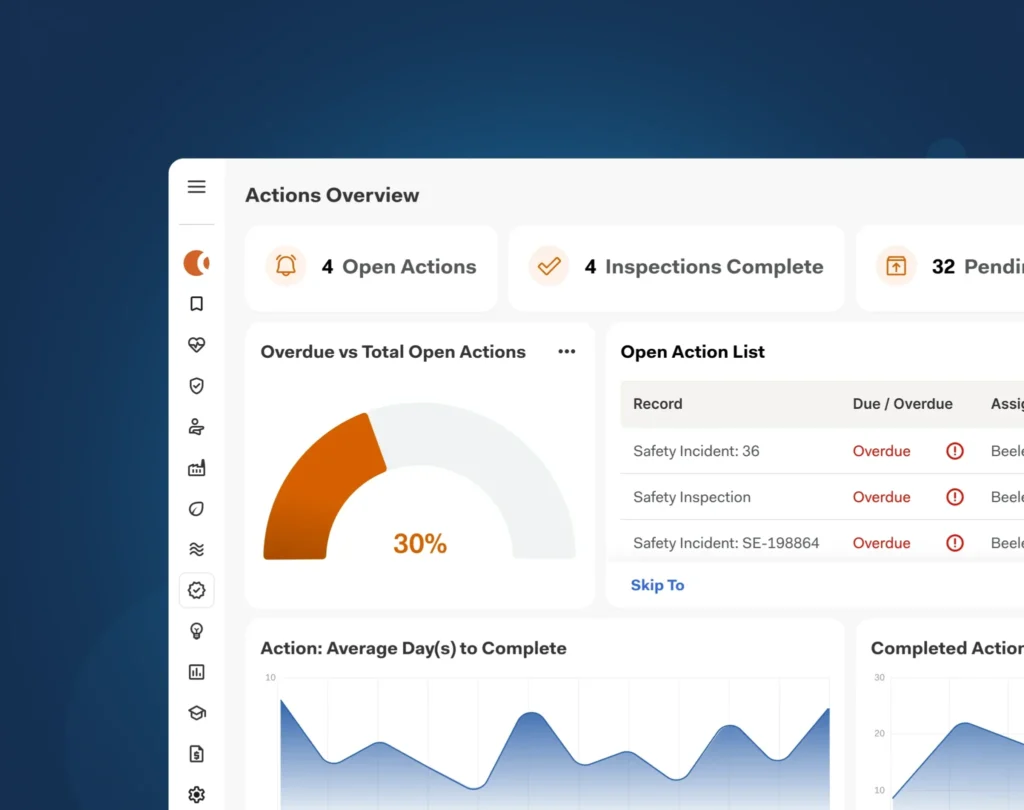
In a disconnected setup, each team re-enters the same incident type, date, time, location, task, hazard and description into its own system, and each copy drifts. The same pattern extends to quality: a product-related incident can open a quality nonconformance.
Organizations that have connected safety and health records report measurable results. A Fortune 100 entertainment company that implemented Cority’s occupational health and safety solutions eliminated redundant data entry, reported 38% fewer injuries and 57% less lost time.
The EHS Incident Management Process, Step by Step
An effective EHS incident management process has six steps, and the fifth step, sharing incident data with the rest of the EHS program, is the one many programs leave out.
- Respond and report. Make the scene safe, provide first aid or medical care and preserve evidence. Then the person closest to the event reports it as soon as it is safe to do so, from the field, including near misses and hazards. Fewer required fields and mobile access raise reporting rates.
- Classify it. Record the event type, severity, regulatory recordability and serious injury and fatality (SIF) potential. SIF potential is assessed separately from actual severity, usually by a supervisor or EHS. Check regulatory notification deadlines at this stage too.
- Investigate the root cause. Gather evidence and use a structured method, such as a why tree, to separate failures in systems and processes from individual behavior.
- Assign corrective and preventive actions. Prioritize actions using the hierarchy of controls, favoring elimination, substitution and engineering controls over retraining and warnings. Give each action an owner, a due date and a way to verify that it worked.
- Share the data downstream. Route the incident record to occupational health, industrial hygiene, risk management, compliance reporting and leadership dashboards without re-entry.
- Measure and learn. Track trends in causes, repeat incidents and leading indicators, and update risk assessments and controls based on what the program finds. Close the loop with the person who reported the event so they can see what changed.
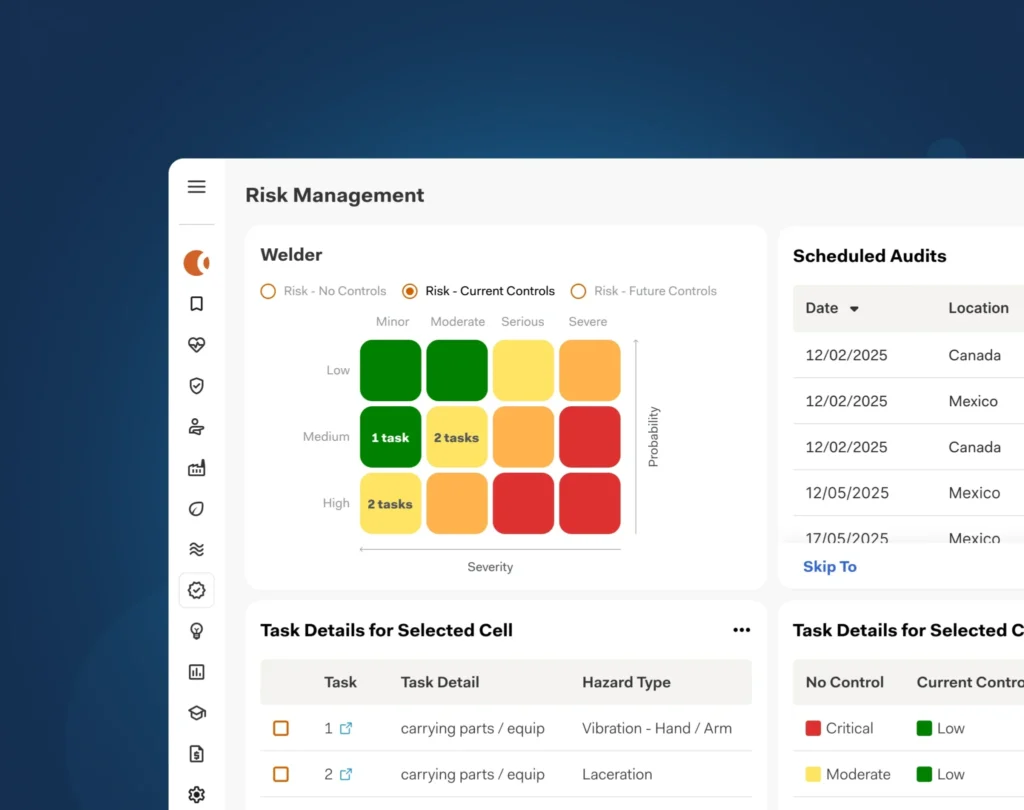
In practice, many programs stop once corrective actions are assigned, even though ISO 45001 and ANSI/ASSP Z10.0 both call for checking whether those actions worked. Steps five and six are where a closed investigation turns into prevention across the organization.
Why Incident Counts and Closure Rates Are the Wrong Measures
Incident counts and closure rates are the wrong primary measures of incident management because they only show what already went wrong and how fast the paperwork moved, not whether the program captured enough to prevent the next event.
Lagging indicators still matter. Leadership, regulators and insurers rely on them. The problem is relying on them alone, and the 82% figure from Cority’s research suggests most organizations do. That reliance creates two blind spots:
- A falling incident count can hide under-reporting. If workers stop reporting minor events and near misses, the count drops while the risk stays the same, and the program loses its earliest warnings.
- A fast closure rate can hide weak investigations. Closing an investigation is not the outcome. What changes afterward is. An investigation that closes quickly with a root cause of “human error” and no change to controls looks efficient and prevents nothing.
GFG Alliance shows what happens when an organization treats reporting volume as a goal rather than a threat. The global mining and metals group, with roughly 35,000 employees, rolled out Cority’s myCority mobile app with reporting reduced to three fields and a 25-minute training course. Frontline employees submitted 25,000 event and hazard reports within three months, nearly 300 per day. GFG credits its broader safety program with a 63% improvement in total recordable frequency rate and a 30% reduction in critical life-threatening incidents since 2021, and its case study reports more than $1 million in workers’ compensation savings.
Reporting went up. Serious harm went down. That is the pattern a strong incident management program should produce, and it points to two better measures.
Measure Reports: How Much Your Program Captures
The first measure of incident management is how much the program captures, because every function downstream can only act on what gets reported.
Why Reporting Rate Matters More Than Incident Rate
Reports and recordable incidents are different numbers. Reports include hazards, near misses and observations, most of which involve no injury. A healthy program usually shows report volume rising or holding steady while recordable injuries fall. A program where both numbers fall at the same time deserves a closer look.
Reporting volume also depends on whether workers trust what happens after they report. Non-punitive reporting policies, a just culture approach to investigations and closing the loop with each reporter all encourage reporting. Incentive programs that reward low injury counts can do the opposite, and OSHA’s recordkeeping rule prohibits retaliating against employees for reporting an injury or illness.
Cority’s research found that the top-performing third of organizations are more likely to put that early data to work: 46% always use leading indicators proactively, compared with 26% of lower performers, and 34% are prepared to act on risk indicators, compared with 13%.
Useful capture metrics include:
- Reports per 100 workers, including contractors, by site
- Ratio of near miss and hazard reports to recordable injuries, tracked as a sign of reporting culture rather than a target
- Share of near miss and hazard reports that identify a high-energy hazard or SIF precursor
- Time from event to report
- Share of reports complete enough to start an investigation without follow-up
Near Miss and Hazard Reporting
Near miss reporting rises when reporting is fast and belongs to the people closest to the work. Before Parkland Corporation moved to Cority, a delivery driver who spotted a hazard had to call a dispatcher or supervisor, often hours later. The supervisor then filed a paper report that was entered into a spreadsheet, so the HSE team had no real-time visibility into risk.
Now drivers stop in a safe location and submit the report from their phones through myCority, and more than 6,000 workers use the system. Sairene Boyd, HSE Program Advisor at Parkland, described the shift: “Supervisors were entering incident information on behalf of their employees, but now … employees enter the initial information, the notification goes to the supervisor, and now the supervisor has the more investigative role, not the data entry role.”
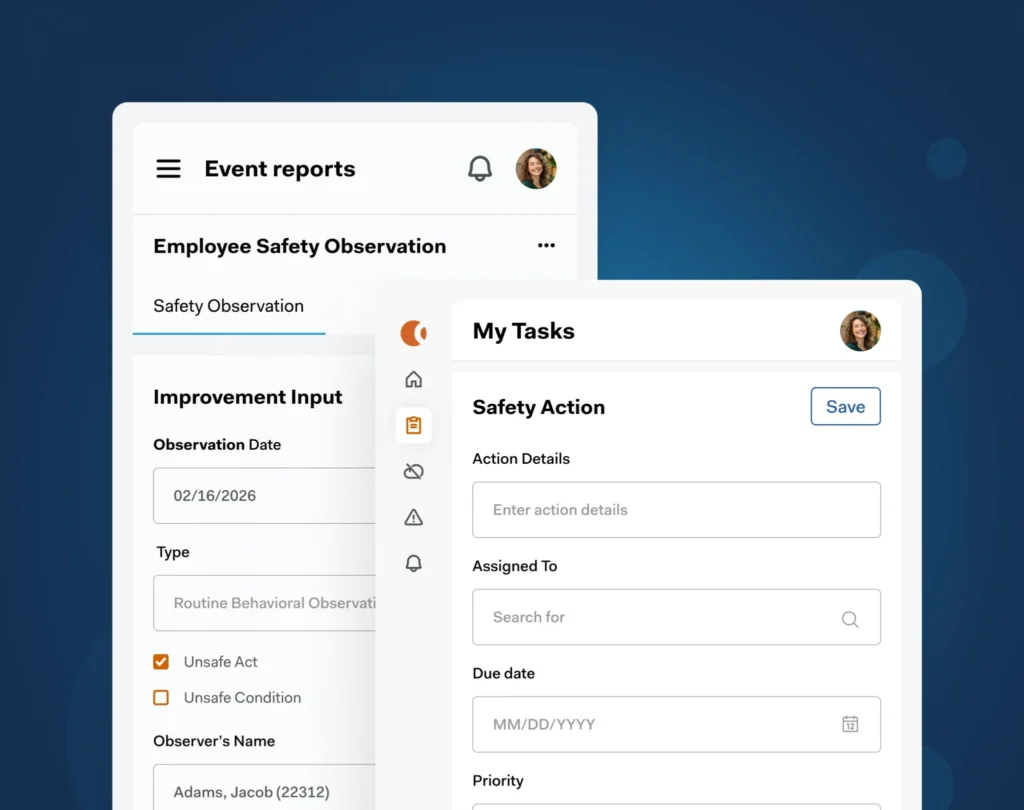
Report quality matters as much as volume. Mandatory fields do not have to slow reporting down: keep the first report short, then require the detail during the investigation, where it matters for analysis.
Building SIF Potential Into Incident Workflows
Not every report carries the same weight, so an effective program classifies serious injury and fatality (SIF) potential as soon as possible and validates it during investigation, not after the fact.
Research from ORCHSE found that about 20% of injury cases examined had SIF potential, and safety researchers have noted that while minor injury rates have declined, SIF statistics have plateaued across industries.
Building SIF classification into the incident workflow lets teams separate the events that could have killed someone from the ones that could not, and direct investigation effort accordingly.
The Edison Electric Institute’s Safety Classification and Learning model, for example, asks whether high energy was present and whether direct controls were in place. Leading indicators that support SIF prevention include:
- Task observations that identified a SIF precursor, such as a missing critical control
- Critical controls in place compared with critical controls required
- Risk assessments completed with SIF precursors identified
Measure Reach: How Far Incident Data Travels
The second measure of incident management is reach, because incident data only prevents harm when it moves beyond the safety team into occupational health, industrial hygiene, risk management and leadership decisions.
Most organizations are not there yet. In Cority’s research, 85% of EHS+ leaders reported operating on manual, disconnected or partially integrated tools, and only 5% have EHS+ data centralized and integrated with enterprise data.
Top performers stand out: 28% have centralized, trusted data, compared with less than 7% of lower performers, and they have cut their use of disconnected tools in half.
Buyers have noticed. According to Verdantix, “buyers are placing greater emphasis on data connectivity, and linking incidents, audits, training records, actions, compliance obligations and risk registers is now a baseline expectation” (Verdantix, Green Quadrant: EHS Software (2026), September 2026).
Connected data changes what an investigation can find. Nicholas Mossop, a Digital Ecosystem Platform Owner described the before state in Cority’s research: “[Before] we couldn’t distinguish failures in behavior from failures in the system, from failures in process. The data and the richness of the quality data set enable us to get to the heart of what the issues are.”
Aptiv shows what reach looks like at global scale. The company, with more than 200,000 employees across 150 facilities in 48 countries, replaced 20 separate internally developed EHS and sustainability systems with the CorityOne platform, bringing safety, environmental, sustainability, industrial hygiene, ergonomics and occupational health data together. In 2025, Aptiv reported fewer than half as many incidents as the year before and its lowest lost-workday case rate in 15 years.
“Having all the information available live allows us to be quicker, more effective,” said Ana Ferreira, Environment, Health and Safety, and Sustainability Director for Systems and Governance at Aptiv.
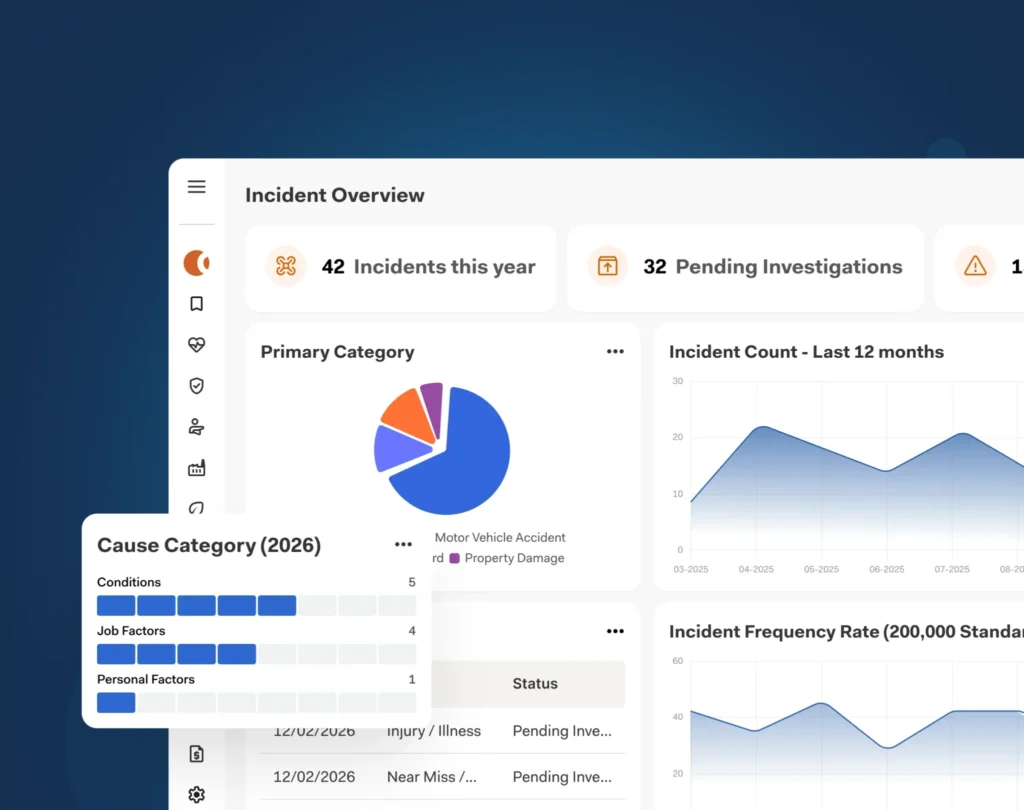
Useful reach metrics include:
- Share of injury and illness incidents with a linked occupational health case
- Time from incident report to clinical evaluation
- Share of corrective actions verified as effective, not just closed
- Repeat incident rate by root cause
- Number of risk assessments updated after an incident
- Share of environmental releases assessed for regulatory reportability within the required timeframe
- Whether leadership can see incident, health and corrective action data in one view
How Can AI Improve Incident Management in EHS?
AI improves EHS incident management most at intake and at the handoff from investigation to corrective action, with a person reviewing each output.
AI is only as useful as the data underneath it. In a Verdantix survey of 302 EHS decision-makers, 27% rated “current EHS data quality is not sufficient or lacks digitization” as the most important barrier to successfully using AI for EHS, the highest share of any barrier listed (Verdantix, Green Quadrant: EHS Software (2026), September 2026).
That makes incident management, where much of that data is first captured, the natural place to start. Cority’s Cortex AI helps at both points, and related agents support the teams that incident data flows to:
| Step | Cortex AI agent | What it does |
|---|---|---|
| Respond and report | Incident Voice Entry Agent | Captures, transcribes and pre-fills incident reports from speech in myCority |
| Respond and report | Incident Image Analysis Agent | Estimates the size, spread and affected areas of a spill or damage from a photo, and prompts for missing details |
| Respond and report | Questionnaire Scanning Agent | Turns handwritten or photographed forms into structured records |
| Investigate | Incident Finding Recommendations Agent | Analyzes incident context and history to suggest likely findings |
| Assign actions | Incident CAPA Recommendations Agent | Pairs findings with recommended corrective and preventive actions |
| Related agents | ||
| Occupational health | Medical Scribe Agent | Turns the occupational health visit into a structured clinical note and summary |
| Environmental | Compliance Permit Analysis Agent | Breaks permits into obligations and limits, so environmental teams can check a release against them |
| Audits | Audit Insights Agent | Surfaces recurring issues and hotspots from audit history |
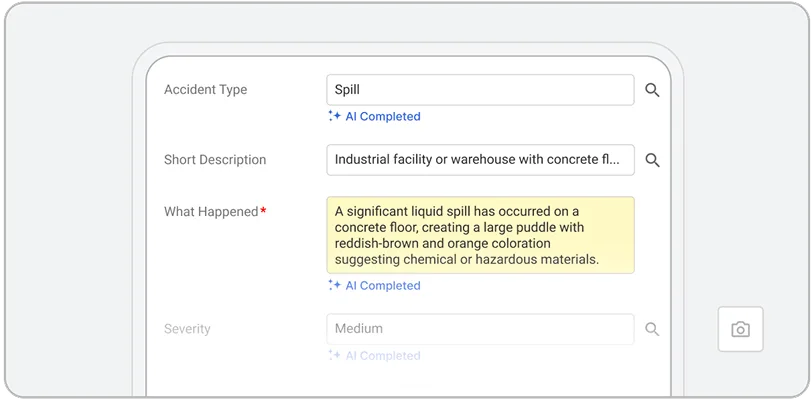
Human control is not optional in this work. All Cortex AI solutions require human oversight and will not complete tasks without human intervention. EHS+ leaders agree: in Cority’s research, 85% prefer to keep humans in command when AI is involved in decisions, and only 15% trust agentic AI to make and act on decisions, even in well-defined scenarios.
“AI should make experts faster and sharper, not replace their judgment,” said Carrie Young, VP, Strategic Solutions at Cority. For incident management, that means AI that helps more workers report, gives investigators a stronger starting point for root cause analysis and keeps the expert in charge of the final call.
EHS Incident Management Scorecard
Use these nine questions to check whether incident management is working as the keystone of the EHS program: four test how much the program captures, and five test how far that data travels.
# | Measure | Question | Yes / No |
|---|---|---|---|
1 | Reports | Can a frontline worker report a hazard or near miss directly from the field, with the supervisor notified automatically? | |
2 | Reports | Is near miss and hazard report volume rising or steady while recordable injuries fall? | |
3 | Reports | Are incidents classified for SIF potential separately from actual severity? | |
4 | Reports | Do most reports arrive complete enough to start an investigation without follow-up? | |
5 | Reach | Are injury and illness reports routed to occupational health or case management when medical follow-up is needed? | |
6 | Reach | Are regulatory and workers’ compensation forms completed from data already entered, without re-keying? | |
7 | Reach | Are risk assessments and exposure monitoring reviewed after relevant incidents? | |
8 | Reach | Are corrective actions verified as effective, not just closed? | |
9 | Reach | Can leadership see incident, health and corrective action data in one view? |
How to score it: 8 to 9 yes answers means incident management is working as the keystone. 4 to 7 means data is captured but stalls between teams, or corrective actions close without proof they worked. 0 to 3 means the program is steering by the rear-view mirror, and the first priority is making reporting fast and simple.
EHS Incident Management FAQs
What is the difference between EHS incident management and safety incident management?
Safety incident management focuses on injuries, near misses and unsafe conditions. EHS incident management also covers occupational illness, health and exposure events, and environmental releases, and it connects those records to occupational health, industrial hygiene and environmental compliance.
What should an EHS incident report include?
At minimum, an EHS incident report should include what happened, when and where, the task being performed, the people and equipment involved, the hazard or energy source, any injury, illness or environmental impact, immediate actions taken, witnesses, and photos or other evidence. Keeping required fields to a minimum at first report and adding detail during the investigation raises reporting rates.
What are leading and lagging indicators in incident management?
Lagging indicators measure harm that already occurred, such as recordable injury rates, lost-time cases and claims. Leading indicators measure activity that predicts and prevents harm, such as near miss and hazard reports, task observations, critical control checks and corrective actions verified as effective.
Where to Start With EHS Incident Management
Start with reports, then reach: make reporting fast enough that frontline workers actually do it, then connect the incident record to every team that depends on it.
Run the scorecard above with the safety, occupational health and industrial hygiene leads in the same room. The gaps usually show up between teams, not within them.
To see how incident reporting, investigations, corrective actions and occupational health cases connect in one system, explore Cority’s EHS incident management software. To see these agents at work, visit the Cortex AI Demo Center.