

Regardless of industry, organizational size, maturity, or other differentiating factors, modern EHS leaders all seem to face the same objective. Improve operational resilience, meet constantly evolving regulatory demands, engage a diverse (and sometimes disparate) workforce – and do so with as few resources and costs as possible.
In the face of these monumental tasks, the professionals that meet this challenge often do so by consolidating their approach. Unified EHS+ software platforms help to simplify organizational digital ecosystems, and beyond the obvious benefits of improved compliance and risk management, offer a compelling advantage to getting C-Suite executives on board; they significantly reduce total cost of ownership.
How exactly does a unified EHS+ software approach reduce the total cost of ownership? Let’s explore the headline effects below.
The Hidden Costs of EHS Software: Why Platform Consolidation Matter
According to a recent Buyers Sentiment Survey, 61% of global firms are actively seeking to consolidate their software and support services into a single provider. The reason? A fragmented network of IT tools and disparate systems places considerable strain on already stretched budgets across an organization. This pain can be felt especially by EHS teams.
In the EHS domain, system fragmentation often results in siloed data, duplicated efforts, and inconsistent reporting. Maintaining multiple systems means higher licensing fees, complex vendor management, and increased IT overhead. A unified platform eliminates these redundancies – streamlining workflows, and centralizing data management.
Software Consolidation Trends in EHS Management
The trend toward consolidation is accelerating across EHS users. In Verdantix’s 2025 Global Corporate Survey, 49% of firms confirmed reducing total cost of ownership was either very important, or their singular most influential criteria when purchasing EHS tools. This aligns with the general market theme researchers have found wherein organizations move toward a single EHS software application as their preferred global deployment option.
Cority’s State of EHS+ Technology report found that 62% of EHS leaders say AI is now pushing them toward integrated platforms — adding fresh urgency to a consolidation trend already driven by cost and complexity.
These organizations recognize that a unified platform not only simplifies operations but also dismantles data silos; a key barrier to process optimization and performance excellence. CorityOne, for example, is designed to simplify the entire journey from evaluation and implementation to adoption and expansion, allowing organizations to focus on outcomes that matter for their people, operations, and long-term resilience.
How Unified EHS Platforms Reduce Implementation Costs
One of the most overlooked contributors to total cost of ownership is the cost of implementation and ongoing upgrades. Traditional systems often require custom coding, manual updates, and expensive consulting support. In contrast, software providers that utilize multi-tenant SaaS architecture ensure all customers remain on the same version, with seamless upgrades and no additional project costs.
This approach not only reduces the financial burden but also ensures organizations stay at the forefront of technology development without disruption
EHS Platform Benefits: Better Adoption, Lower Training Costs
User adoption is critical to realizing the full value of any software investment. Industry analysts often caution that inconsistent user experiences across modules can hinder engagement and sustainability.
EHS professionals can address this by identifying technology partners that offer a unified, intuitive interface across all EHS domains, from audits and inspections to occupational health and ESG reporting. This consistency reduces training costs, accelerates onboarding, and improves data quality—further lowering operational expenses
Reduce EHS Software Costs with No-Code Configuration
Highly customized systems may seem attractive initially but often become costly to maintain and upgrade. Tools such as CorityOne offer no-code configurability, allowing organizations to tailor workflows and dashboards without relying on vendor intervention or expensive development projects.
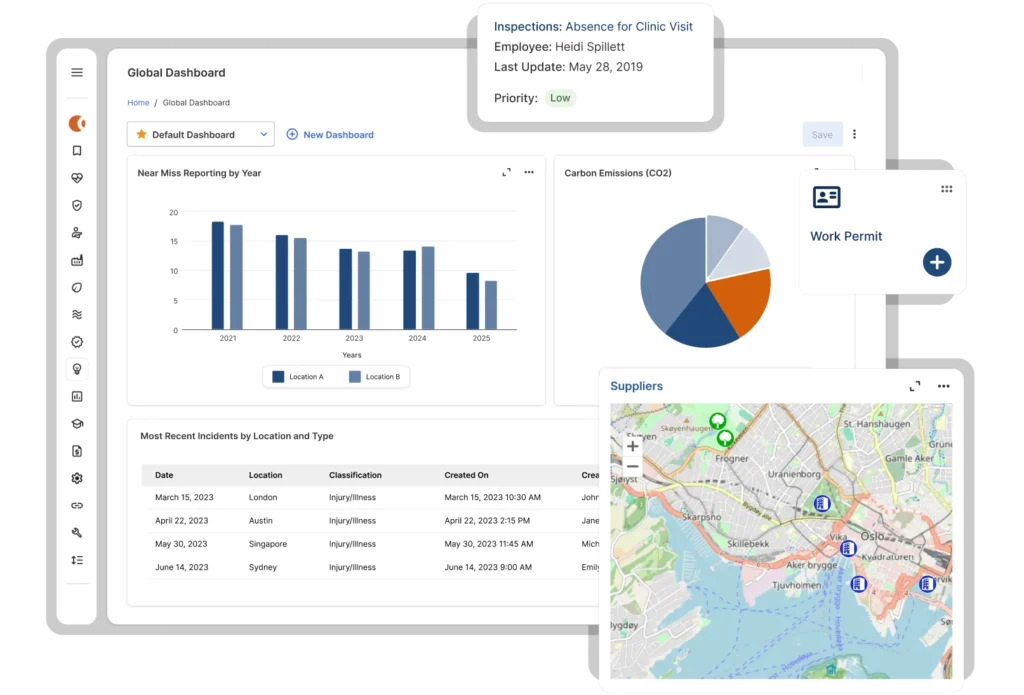
This flexibility ensures that the platform evolves with the business, without incurring the hidden costs associated with legacy systems.
EHS Software Pricing ROI: $500K Annual Savings Case Study
The financial impact of unified EHS software is not just theoretical. Cority customer CSX Transportation reported $500,000 in annual savings after implementing Cority’s medical surveillance module. By consolidating their mobile medical testing program into a single platform, they reduced costs from $1.2 million to $700,000 per year.
This is a powerful example of how targeted consolidation can yield measurable ROI while improving program efficiency – all while reducing total cost of ownership.
Unified EHS Software for ESG Compliance and Cost Reduction
As ESG regulations introduce new data auditability requirements, many firms are seeing the value of combining EHS and ESG data in a single application. A unified platform enhances data traceability, reporting accuracy, and decision-making, reducing the risk of non-compliance and associated penalties.
Moreover, centralized compliance management automates updates and closes gaps across global facilities, further reducing the cost of regulatory oversight.
Reduce Your EHS Software Costs with CorityOne
To secure investment in unified EHS software, organizations must build a compelling business case. In a recent report titled “Best Practices: Reassessing EHS Digital Strategy In 2025”, Verdantix recommends aligning EHS and ESG needs to maximize budgets and engaging IT experts early to ensure the solution fits within the broader digital strategy.
By demonstrating shared benefits across departments, from operations to sustainability, teams can unlock funding and drive strategic transformation.
Unified EHS software platforms like CorityOne offer more than operational efficiency; they deliver long-term financial value. By reducing system complexity, streamlining upgrades, improving user adoption, and enabling smarter compliance, these platforms help organizations lower their total cost of ownership while building a safer, more resilient future.