


The best environmental compliance software is not the one with the longest module list. Nearly every enterprise EHS platform now covers air, water, waste, and permits.
The best one is the platform whose calculations an environmental team can see, defend in an audit, and maintain without calling a consultant.
That distinction carries real stakes. Environmental reporting rests on thousands of calculations. A single miscalculated total or missed exceedance can become a reportable violation that regulators and the public can see.
When a platform hides how it reaches its numbers, the team that owns the permit carries the risk.
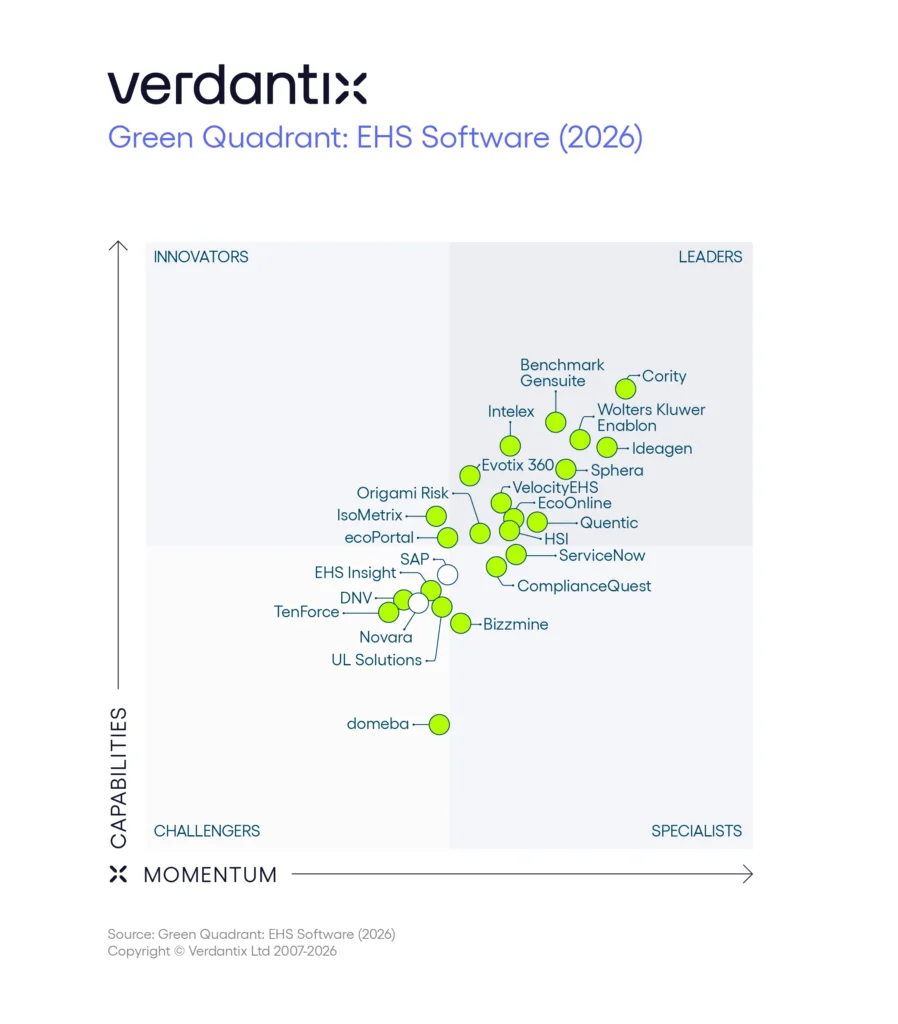
This guide draws on the 2026 Gartner Market Guide for Environmental, Health and Safety Software, the Verdantix Green Quadrant: EHS Software (2026), and two recent air emissions implementations at a U.S. refinery and a global energy company.
Rather than crown a single winner, it routes each reader to the platforms that fit their permits, their sites, and their program. Find the profile below that matches the situation.
If this sounds like your organization | Start here | Platforms to compare |
|---|---|---|
Permit-Heavy Operator: environmental manager at a refinery, chemical plant, terminal, or utility carrying Title V and GHG Reporting Program obligations, often with hourly limits and hundreds of emission sources | Cority is built for this profile | Cority, Sphera, Wolters Kluwer (Enablon) |
Multi-Site Environmental Program Leader: head of environment or EHS director standardizing air, water, waste, and chemicals management across many sites, and connecting environmental data to broader EHS and sustainability reporting efforts | Cority (specifically the CorityOne platform) is built for this profile | Cority, VelocityEHS, Benchmark Gensuite, Intelex, Sphera |
Single-Site Compliance Tracker: compliance coordinator at one or a few facilities with a handful of permits who mainly needs deadlines, tasks, and routine reports tracked | Begin with a focused tool, then plan to consolidate to future-proof efforts | A general compliance calendar tool; ERA Environmental for smaller manufacturers |
What makes the best environmental compliance software?
Environmental compliance software looks interchangeable on a feature list. Air emissions, water, waste, hazardous materials, permits, and chemical management appear on nearly every enterprise vendor’s website.
Gartner’s 2026 Market Guide makes the same point about EHS software broadly: “The core functionality of EHS software has remained consistent over the years, but differentiators like usability, configurability, integration and domain expertise are directing buying decisions.”
What separates platforms is what happens inside the modules: how data comes in, how emissions are calculated, and whether anyone can trace a reported figure back to its source.
The black box problem
Many legacy environmental systems work as black boxes. Teams can see the final number, but not how the system preprocessed the data or which emission factor it applied. When an auditor asks how a figure was calculated, nobody can show the work.
Many legacy systems also store only aggregated totals, such as a monthly figure, rather than the hourly or shorter-interval data some permits require. Without that detail, a team cannot prove compliance with short-term limits or catch a problem before the period closes.
The workarounds are predictable. Teams rebuild the logic in spreadsheets, or pay consultants to maintain calculations they cannot change themselves. One U.S. refinery that later moved to Cority was spending upwards of $200,000 a year on outside consultants to keep its legacy system running.
The problem compounds because the same emission sources report to several programs. A U.S. oil and gas operator may report the same equipment under its Title V operating permit, the EPA Greenhouse Gas Reporting Program, and state or local programs, each with different data formats and calculation methods. If the platform cannot reconcile those methods transparently, the numbers drift apart.
The four options buyers compare
- Enterprise EHS platforms manage environmental compliance alongside safety, health, and sustainability on one data foundation. They suit multi-site programs that span several media.
- Specialist environmental software focuses on environmental data and agency reporting, such as air emissions, waste, and water, with little coverage of safety or occupational health. It suits organizations whose main need is environmental reporting rather than a full EHS program.
- Compliance calendar tools track deadlines and tasks that users enter by hand. They do not pull data from air, water, or waste programs, so they cannot monitor, calculate, or report. They suit a few straightforward permits.
- Spreadsheets are flexible and familiar, but hard to audit and dependent on the person who built them.
The rest of this guide focuses on the first two categories, where most permit-driven environmental programs land.
Where Cority fits, and where it does not
Cority is built for organizations whose environmental programs have outgrown spreadsheets and black-box systems: permit-heavy facilities, multi-site operations, and teams that need to defend every number they report. It brings air, water, waste, and chemical compliance together on one platform, backed by more than 40 years of environmental software experience, including Enviance.
Where Cority is strong
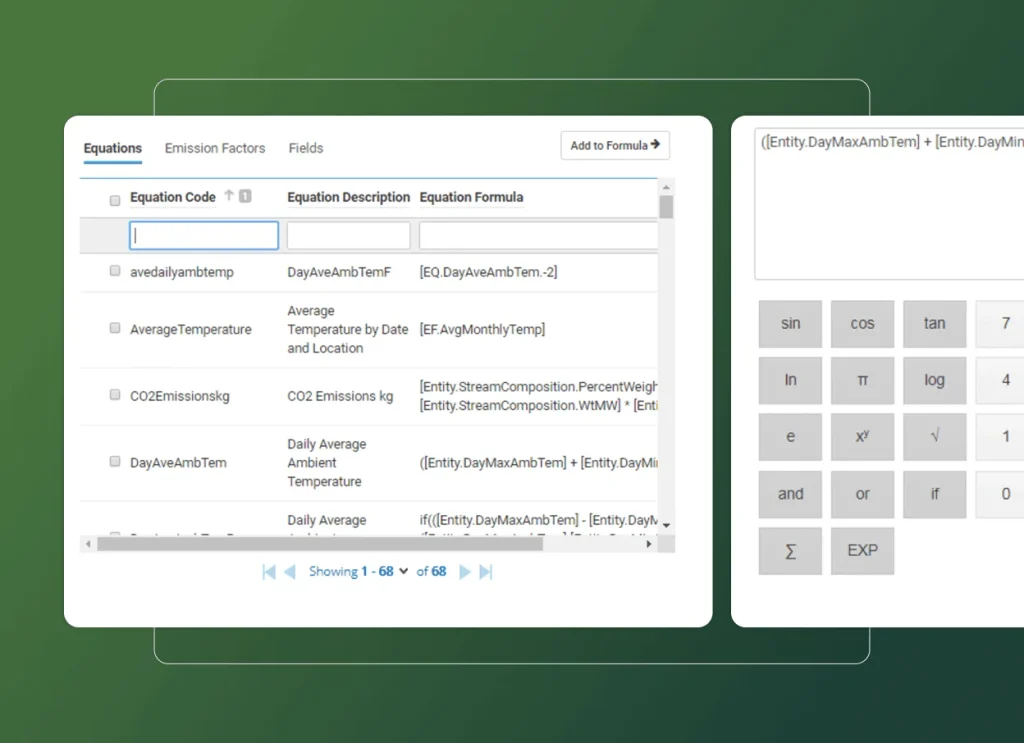
- Transparent, high-volume calculations. Cority handles minute-level, high-volume emissions calculations and shows the work behind every result, including a calculation graph that visualizes how each number is produced. That transparency lets a team defend a figure in an audit instead of reconstructing it.
- Self-service configuration. Environmental teams can add sites, permits, and calculation changes themselves rather than waiting on a services project. At the refinery described above, that shift cut consultant spending by 75 percent.
- One platform, one provider. Air, water, waste, and chemicals run on the same platform, delivered as true SaaS with one-click upgrades.
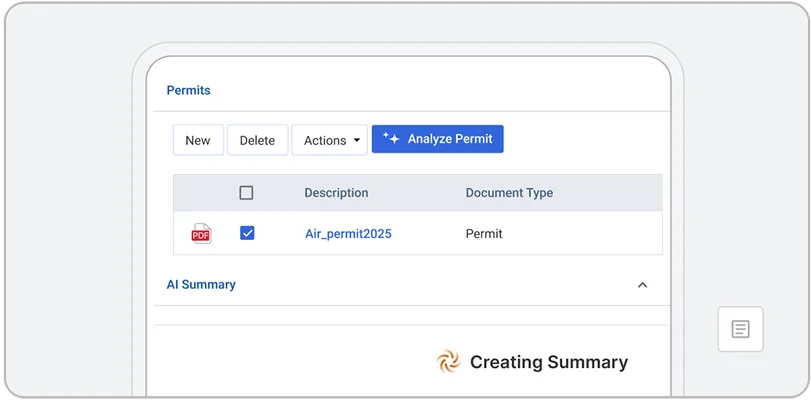
- AI inside the workflow. The Cortex AI Compliance Permit Analysis Agent turns a dense permit into a list of obligations and tasks for a person to review. Cority estimates that deconstructing a complex air permit by hand can take around 80 hours; the agent produces a draft for review in about 30 minutes.
- Analyst recognition. Cority is recognized as a Representative Vendor in the 2026 Gartner Market Guide for Environmental, Health and Safety Software, and is a Leader in the Verdantix Green Quadrant: EHS Software (2026), with criterion scores of 2.6 for air emissions, 2.7 for GHG emissions, and 2.5 for hazardous waste (Verdantix, Green Quadrant: EHS Software (2026), September 21, 2026).
Where Cority is not the right fit
- A single facility with a few straightforward permits. If the main need is tracking deadlines, a compliance calendar tool will cost less and do the job.
- Buyers who only need a tool for today’s requirements. Every platform requires some configuration; the difference is whether it keeps adapting after go-live. Cority’s calculations are configured to each site’s permits and sources, which pays off as the program grows but is more than a simple program needs.
- Teams that need to be live in weeks. Environmental implementations configure every emission source and calculation to each site’s permits, so they take months rather than weeks.
How to evaluate environmental compliance software: the permit-to-report lifecycle
Every environmental obligation moves through the same five stages, from the moment a permit is issued to the moment a report is filed. A platform that is strong at one stage and weak at another leaves a gap that someone fills by hand. Testing each stage separately shows exactly where that gap sits.
Stage | The real question to ask |
|---|---|
1. Obligations | Does the platform turn permits and regulations into tracked obligations with owners and revision history, or does someone retype them into a calendar? |
2. Data capture | Can it accept the data the team already has, from CEMS, process historians, lab results, utility invoices, and manifests, without re-keying it? |
3. Calculation | Can the team see and change every calculation, emission factor, and method, and trace any reported number back to its source? |
4. Monitoring and response | Does it flag exceedances and deviations against permit limits before they become violations, and turn each one into a tracked corrective action? |
5. Reporting and proof | Can it produce agency-ready reports and an audit trail that shows who entered each number, how it was calculated, and what changed? |
1. Obligations
Permits are dense legal documents, and compliance starts with turning each condition, limit, and deadline into a tracked obligation with an owner. Strong platforms keep permit revision history and assess which regulations apply to each site. AI can now read a permit and draft its obligations, but a qualified person should review every one before it goes live.
2. Data capture
Environmental data arrives from continuous emissions monitoring systems (CEMS), process historians, lab results, utility invoices, waste manifests, and field forms. The question is whether the platform accepts that data where it lives, through APIs and scheduled uploads, or forces someone to re-key it. Every manual transfer adds an error that an auditor may find before the team does.
3. Calculation: the black box test
This is the stage that separates platforms. The team should be able to open any calculation, see the inputs, emission factors, and method behind it, and change it without filing a support ticket. When the refinery described above rebuilt its calculations in a transparent system, the process surfaced errors in its legacy equations, and every emission factor could finally be traced back to its original data source.
4. Monitoring and response
Compliance is decided between reports, not at them. The platform should compare incoming data against permit limits continuously, alert the right people as values approach a limit, and turn an exceedance or deviation into a tracked corrective action. If the response lives in email, the audit trail ends at the alert.
5. Reporting and proof
The last stage is agency-ready output, such as Title V monitoring reports and annual compliance certifications, GHG Reporting Program submissions, Toxics Release Inventory reports, discharge monitoring reports, and electronic waste manifests. Just as important is the trail behind each number: who entered it, which calculation produced it, and what changed since the last report. A platform that cannot show that trail turns every audit into a reconstruction project.
Best environmental compliance software in 2026: Cority compared to the top alternatives
The platforms below are the ones environmental buyers most often evaluate: enterprise EHS platforms profiled in 2026 analyst research, and specialist environmental software vendors that appear in buyer searches. Each fits a different profile. Single-site teams that only need permit deadlines tracked may also consider dedicated compliance calendar tools, which center on deadlines and tasks rather than emissions calculations.
Platform | Category | Best for | Environmental strengths | Where it differs from Cority |
|---|---|---|---|---|
Cority | Enterprise EHS platform | Permit-Heavy Operator; Multi-Site Environmental Program Leader | Configurable, auditable calculation engine; air, water, waste, chemicals, and compliance management on one platform; AI permit analysis | Reference platform |
Sphera | Enterprise EHS and operational risk platform | Permit-Heavy Operator at large, high-emitting enterprises | High-volume air, GHG, water, and waste calculations with audit logs and version control; state inventory, TRI, and GHG reporting | Environmental accounting sits inside a broad operational risk portfolio |
Wolters Kluwer (Enablon) | Enterprise EHS platform | Permit-Heavy Operator with strong internal IT | Air compliance, water permits and discharge logs, waste lifecycle tracking, GHG, ISO 14001 | Partner-led implementation model |
VelocityEHS | EHS platform | Multi-Site Environmental Program Leader who also prioritizes chemical management and ergonomics | CEMS logging, OSIsoft PI integration, hybrid equation engine, permit threshold alerts, potential-to-emit modeling | Broader platform emphasis on chemical management, safety, and ergonomics |
Benchmark Gensuite | EHS and ESG platform | Multi-Site Environmental Program Leader focused on permit-driven tasks | Air, water, waste, permit compliance, and refrigerant leak modules; AI Permit Agent | Configuration changes typically go through vendor support tickets rather than in-house admins |
Intelex | EHS and quality platform | Multi-Site Environmental Program Leader running environmental and quality programs together | Modifiable emission factors and methods; GHG Reporting Program and eGRID factor library; escalating permit alerts; Scope 1 to 3 tracking | Broader platform emphasis on quality management |
ERA Environmental | Specialist environmental software | Smaller manufacturers focused on environmental reporting | Air emissions, GHG, waste, water, hazardous materials, permits, and SDS authoring for manufacturers | Narrower scope than an enterprise EHS platform |
The demo script: what to ask environmental compliance vendors
Every vendor demo is designed to look good. The questions below force a platform to show its work on real permits and real data, which is where weak systems give themselves away.
Air
- Show me one hourly emission limit from my permit. Where does the hourly data come from, how is the limit evaluated, and what happens in the system when a value exceeds it?
- Open a storage tank calculation built on AP-42 Chapter 7. Show the inputs, the emission factors, and who last changed them. Then change the tank’s contents and rerun it while I watch.
- The same heater reports under Title V and the GHG Reporting Program. Show both results for that source and explain any difference between them.
Water
- Load a lab report that includes a non-detect, a qualified result, and a missed sample. Show how each one flows into the DMR.
- Add a new parameter, such as a PFAS compound, to one outfall with its own limit and sampling frequency. How long does it take, and who can do it?
Waste
- Show an accumulation area approaching its time or volume limit. Who gets alerted, and how far ahead?
- Walk one shipment from container to signed manifest. How does it connect to EPA’s e-Manifest system, and how does that manifest data reach the biennial report?
Permits and compliance tracking
- Upload one of my permits. Show every obligation the AI drafted, the permit condition each one came from, and the step where a person approves or rejects it.
- The permit is renewed with three changed conditions. Show how the existing tasks update and where the revision history lives.
Where weak platforms fall apart
Usually in one of three places.
- The vendor will only demo its own sample data.
- A change to a calculation needs a services quote.
- A reported total cannot be traced back to the hourly or source-level record behind it.
What to bring to the demo
Bring one real permit, 12 months of data for two or three of your hardest sources, last year’s submitted report for those sources, and the spreadsheet the team uses today. Ask the vendor to reproduce one reported number from the raw data. If the numbers do not match, ask why before the demo ends.
What switching environmental compliance software looks like
Most environmental teams do not choose new software from a blank slate. They switch because a legacy system is being retired, a vendor is leaving the market, or the spreadsheets around the system have quietly become the real system. Two recent Cority implementations show what that switch involves.
Migration is when the old numbers get tested
A major U.S. oil refinery in a non-attainment area needed to replace a legacy environmental system that was being sunset. The facility needed hourly calculations across all 210 storage tanks and 410 process units. Rebuilding those calculations in a transparent system surfaced errors in the legacy equations, and every emission factor and input could now be traced back to its original data source.
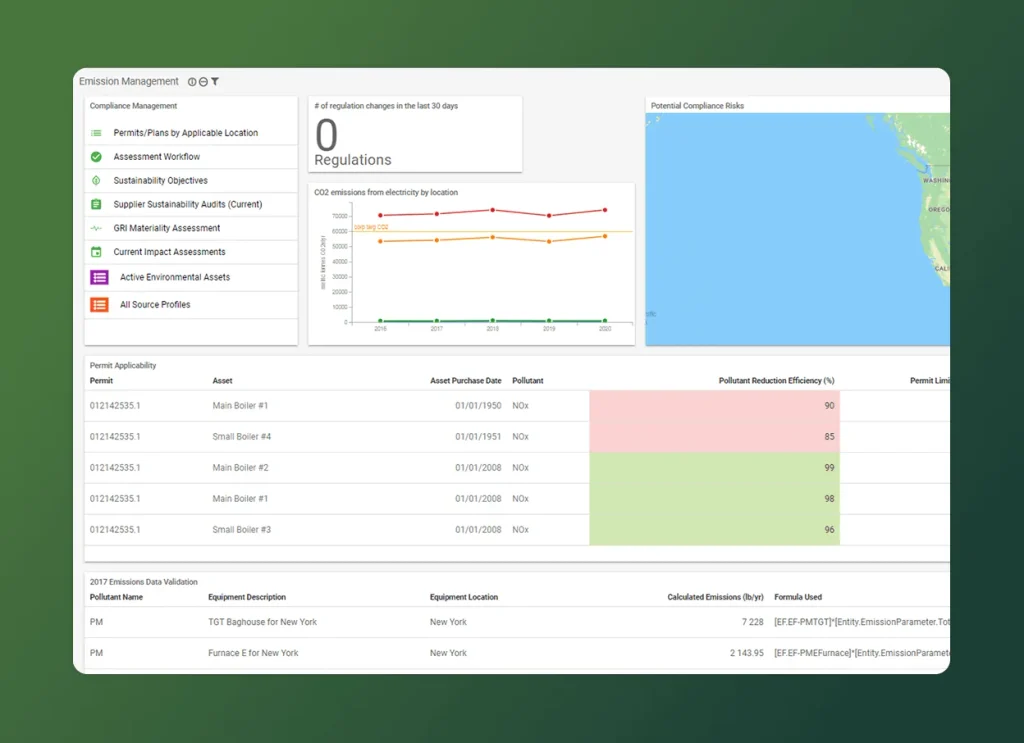
Once live, the facility’s annual air emissions report was approved four weeks earlier than in past years, consultant costs dropped 75 percent, from $200,000 to $50,000 a year, and a process that took nine separate file pulls became a one-click output. “That is the earliest we have ever gotten it done,” the facility’s EHS manager said.
Phase the rollout to reduce risk
A global energy supermajor took a different path after a failed air and greenhouse gas implementation with another vendor. Working with implementation partner ERM, it rolled out Cority Air Emissions Management in stages, completing a global GHG deployment over roughly two and a half years. Careful data mapping during migration preserved the longest possible lookback of historical data.
Lessons for any environmental software project
- Decide the data lookback early. How many years of history must move, and from which systems, shapes the whole migration plan.
- Expect integration plans to change. The refinery lost its planned internal IT support halfway through the project, so Cority and ERM developed a lower-cost integration method instead.
- Budget for the right expertise. Both projects relied on an environmental consultancy that understood the regulations, not just the software.
For the supermajor’s EHS manager, the old process came down to proof: “To be able to audit, to be able to show to ourselves or to a regulator, this is how we’re doing our calculation from beginning to end, was an intensely manual process.” With Cority, a correction is immediately available for re-reporting.
Which environmental compliance software is best for your organization?
There is no single “best” environmental compliance software. The right platform depends on how complex the permits are, how many sites and media the program covers, and how much the team needs to own its own calculations. Module coverage is the wrong lens; transparency across the permit-to-report lifecycle is the right one.
- For a Permit-Heavy Operator, the priority is calculation depth and an audit trail that holds up line by line. Cority is built for this profile, and Sphera and Wolters Kluwer (Enablon) are worth comparing against it.
- For a Multi-Site Environmental Program Leader, the priority is standardizing air, water, waste, and chemicals on one platform connected to the rest of the EHS program. Cority (specifically the CorityOne platform) fits this profile, alongside VelocityEHS, Benchmark Gensuite, Intelex, and Sphera.
- For a Single-Site Compliance Tracker, the priority is keeping deadlines from slipping. A compliance calendar tool or a specialist such as ERA Environmental is a sensible starting point, with a plan to consolidate as the program grows.
The fastest way to test a shortlist is to bring a real permit and 12 months of data for the hardest sources to every demo, and ask each vendor to reproduce one reported number from the raw data. Organizations that want to see how Cority handles their own permits can request an environmental demo built around them.
FAQ: Choosing environmental compliance software
What is environmental compliance software?
Environmental compliance software helps organizations track permit and regulatory obligations, collect and calculate environmental data, monitor results against limits, and file required reports. It typically covers air emissions, water, waste, hazardous materials, and chemicals. Enterprise platforms also connect that data to incident management, corrective actions, and sustainability reporting.
What is the best environmental compliance software in 2026?
No single platform is best for every organization; the right choice depends on permit complexity, the number of sites, and how broad the program is. Permit-heavy industrial operations and multi-site programs are usually best served by an enterprise EHS platform with a transparent, configurable calculation engine, such as Cority, Sphera, Wolters Kluwer (Enablon), VelocityEHS, Benchmark Gensuite, or Intelex. A single site with a few simple permits may only need a compliance calendar tool.
What is the difference between environmental compliance software and an ISO 14001 environmental management system?
An environmental management system is a management framework, most often built to the ISO 14001 standard, that defines how an organization plans, controls, and improves its environmental performance. Environmental compliance software is a tool that supports that framework by tracking obligations, data, and reports. Software can make certification easier, but ISO 14001 certification depends on the management system itself.
What is the difference between environmental compliance software and ESG reporting software?
Environmental compliance software manages operational obligations at the facility level, such as permit limits, emissions calculations, and agency reports. ESG reporting software consolidates data for disclosure frameworks and stakeholders. The two connect because facility emissions, water, and waste data often feed ESG reports.
Which regulations does environmental compliance software support?
In the United States, it commonly supports Clean Air Act programs such as Title V operating permits, the EPA Greenhouse Gas Reporting Program, Toxics Release Inventory reporting, RCRA hazardous waste requirements, Clean Water Act discharge monitoring reports, and EPCRA Tier II chemical inventory reporting. Coverage of state, local, and international programs varies by vendor. Buyers should ask each vendor to produce their own required reports during a demo.
How long does it take to implement environmental compliance software?
According to Gartner, “While timelines are impacted by organizational size, complexity and integration requirements, some implementations can go live in as little as four to 12 weeks, whereas highly complex, enterprisewide rollouts typically span from six through 18 months.” Environmental projects tend toward the longer end because each emission source and calculation must be configured and historical data migrated. A phased approach, starting with compliance management and adding environmental data management later, reduces risk.
When should a team move from spreadsheets to environmental compliance software?
The clearest signals are reported numbers nobody can trace, reports assembled from many separate files, and calculations only one person understands. Teams paying consultants to maintain calculations, or facing new permit conditions, usually see the fastest return. A pending audit or a retiring system owner is often the trigger to act.
How is AI used in environmental compliance?
AI is starting to automate the most manual parts of environmental compliance, such as reading permits and drafting obligations, extracting usage data from utility invoices, and recommending corrective actions. Cority’s Cortex AI Compliance Permit Analysis Agent, for example, deconstructs permits into compliance actions for a person to review. Every AI-drafted obligation should still be reviewed by a qualified person before it becomes part of the compliance record.
Sources: Gartner, Market Guide for Environmental, Health and Safety Software, Kevin Lawrence, 11 May 2026. Verdantix, Green Quadrant: EHS Software (2026), September 21, 2026.
GARTNER is a trademark of Gartner, Inc. and/or its affiliates. Gartner does not endorse any company, vendor, product or service depicted in its publications, and does not advise technology users to select only those vendors with the highest ratings or other designation. Gartner publications consist of the opinions of Gartner’s business and technology insights organization and should not be construed as statements of fact. Gartner disclaims all warranties, expressed or implied, with respect to this publication, including any warranties of merchantability or fitness for a particular purpose.