
3 EHS Regulatory Shifts Coming to Australia in 2026 — Are You Ready?

2026 marks a turning point in Australia regulatory landscape. After years of legislative development, the focus is shifting decisively from policy creation to practical implementation and enforcement. In this interview, Henrietta Tweedy, Legal Content Owner, at ERM Libryo, shares insights on the key regulatory and environmental, health and safety (EHS) trends that organizations across the region need to be aware […]
2026 Regulatory Changes in the EU and UK: A Guide for EHS Teams

Across the EU and UK, 2026 is when new laws start being put into everyday practice, and that means compliance stakes are rising as a result. To understand what this shift means in practice, we sat down with Henrietta Tweedy, Legal Content Owner, at ERM Libryo, to discuss the key regulatory and environmental, health and safety (EHS) developments organizations across EMEA […]
Cority Partners with Carahsoft to Bring Its FedRAMP-Authorized EHS Platform to Government Agencies Nationwide
First FedRAMP-authorized EHS platform supports mission-critical federal, state, and local programs Toronto, ON — February 11, 2026 — Cority, the converged platform for preventing EHS+ risks in operations, today announced a strategic agreement with Carahsoft Technology Corp., the Trusted Government IT Solutions Provider, to expand access to CorityOne for U.S. federal, state, and local agencies. […]
Cority Launches in Saudi Arabia to Support Safer, Smarter Operations Aligned with Vision 2030

Trusted AI-powered EHS solutions help organizations manage risk, protect workers, and meet rising regulatory demands across the Kingdom Toronto, ON — January 28, 2026 — Cority, the global leader in EHS and sustainability software, today announced its expansion into Saudi Arabia, establishing the Kingdom as its Middle East and North Africa (MENA) regional headquarters, to support organizations operating in one […]
Deminar: AI You Can Trust- Transforming Safety Performance with Cortex AI™
Artificial Intelligence is reshaping how organizations manage Safety. In this interactive Deminar, we’ll explore how Cortex AI™, an embedded intelligence layer within CorityOne, helps you unlock new levels of efficiency, insight, and risk control.
Safer is Stronger: A New Approach to Safety, Accountability, and Execution for Mid-Market Organizations
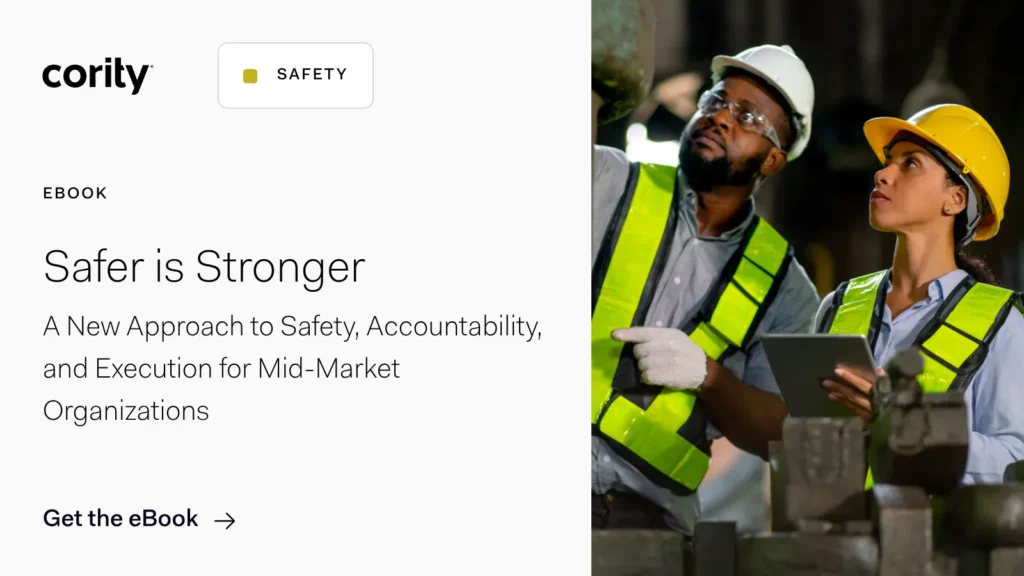
This guide helps safety and operations leaders move beyond reactive, manual processes. Learn a data-driven approach that prevents incidents before they happen. Safety programs are under more pressure than ever. Regulations are expanding. Expectations are rising. And when something goes wrong, the consequences hit harder — for your people and your bottom line. But most […]
Building Connected Environmental and Sustainability Teams

Environmental and sustainability teams often share similar goals, yet they operate in very different ways. When those differences aren’t aligned, organizations miss opportunities for improvement. In this blog, we aim to show how connecting teams is the first step toward creating a more resilient, credible, and effective sustainability program. Why Collaboration Breaks Down Between Sustainability Teams Environmental and sustainability teams are both essential to enabling and meeting critical EHS+ objectives, but their […]
AI for Workplace Safety: Predict, Prevent, and Protect Your Workforce

AI for workplace safety is no longer a futuristic concept — it’s rapidly becoming a cornerstone of modern safety strategies. According to Verdantix, 94% of firms report that implementing AI to boost Environmental Health and Safety (EHS) automation and realize time savings is a top priority within the next two years.1 This surge in interest reflects a growing […]
Verdantix Report: Future of AI-Enabled EHS Software Solutions
Artificial intelligence is no longer a futuristic promise. It’s actively transforming the way EHS software is developed, deployed, and adopted. In this timely report from Verdantix, analysts examine how the AI revolution is creating a new competitive landscape for EHS software vendors. From AI-augmented legacy platforms to fast-moving AI-native disruptors, this report covers it all. […]
Deminar: AI You Can Trust – Health
Cortex AI™ is redefining how Occupational Health teams work. Join this interactive deminar to see Cority’s newly launched AI capabilities in action and learn how trusted, embedded intelligence can streamline documentation, improve data accuracy, and preserve human oversight.