

Environmental and sustainability teams often share similar goals, yet they operate in very different ways. When those differences aren’t aligned, organizations miss opportunities for improvement.
In this blog, we aim to show how connecting teams is the first step toward creating a more resilient, credible, and effective sustainability program.
Why Collaboration Breaks Down Between Sustainability Teams
Environmental and sustainability teams are both essential to enabling and meeting critical EHS+ objectives, but their day-to-day priorities sit at different levels of the organization. This natural separation is often where collaboration starts to break down.
The Team Gap
Environmental teams typically operate at the operational level. Their work centers on regulatory compliance and risk control, managing detailed site-level requirements such as air emissions, waste disposal, water discharges, permits, and incidents. Accuracy, consistency, and adherence to regulations are critical, as errors can lead to fines, operational disruption, or safety risks.
Sustainability teams, on the other hand, are more strategy-led and market-focused. They collaborate closely with internal functions such as finance, procurement, risk, and corporate strategy to define long-term goals like Net Zero, track performance against targets, and report against voluntary and mandatory frameworks and regulations, including CDP, GRI, CSRD, and the California Climate laws. Their role is forward-looking, focused on progress, transparency, and stakeholder expectations.
The Impact of Silos
When these teams operate independently, the consequences quickly become visible:
Existing Processes or Gaps | Impact |
Separate tools, processes, or spreadsheets | Duplicated work and inconsistent figures |
Different assumptions or calculation methods | Conflicting results across reports |
Limited visibility into each other’s work | Slower decision-making and rework |
Parallel efforts toward similar goals | Missed opportunities for alignment and efficiency |
Without coordination, teams may be working toward the same outcomes but in disconnected ways. This not only increases effort but also weakens confidence in the data and the story being told externally.
What Connected Teams Look Like
Despite their different perspectives, environmental and sustainability teams ultimately share a common purpose: managing environmental impact, meeting compliance requirements, reducing risk, and improving long-term performance.
When teams are aligned and their processes are integrated, the benefits extend far beyond operational efficiency.
Connected teams are able to:
- Reduce greenhouse gas emissions across all scopes, not just within direct operations
- Improve the accuracy and efficiency of reporting
- Deliver consistent, credible information to regulators, investors, and other stakeholders
- Develop stronger, more resilient sustainability programs grounded in operational reality
Alignment also enables joint strategy development. Environmental teams bring deep operational insight, while sustainability teams translate that insight into long-term targets and external commitments. Together, they can identify where operational improvements directly support strategic goals.
Perhaps most importantly, sharing the workload removes repetitive tasks. This creates time and capacity for higher-value activities such as innovation, exploring new technologies, strengthening resilience, and proactively managing emerging risks.
How Software Supports Connected Sustainability Teams
Software enables collaboration by improving how teams work together, not by replacing them. The right platform connects people, processes, and systems, removing friction and standardizing ways of working, so everyone operates from a shared foundation. By merging asset-level tracking from environmental teams with sustainability reporting, software provides a complete picture, enables stronger decision-making, and supports better collaboration. Enterprise platforms like Cority support multiple teams within a single unified ecosystem while tailoring experiences to different roles. Environmental teams can focus on compliance and operational detail, while sustainability teams model performance and track long-term goals, all within the same connected platform.
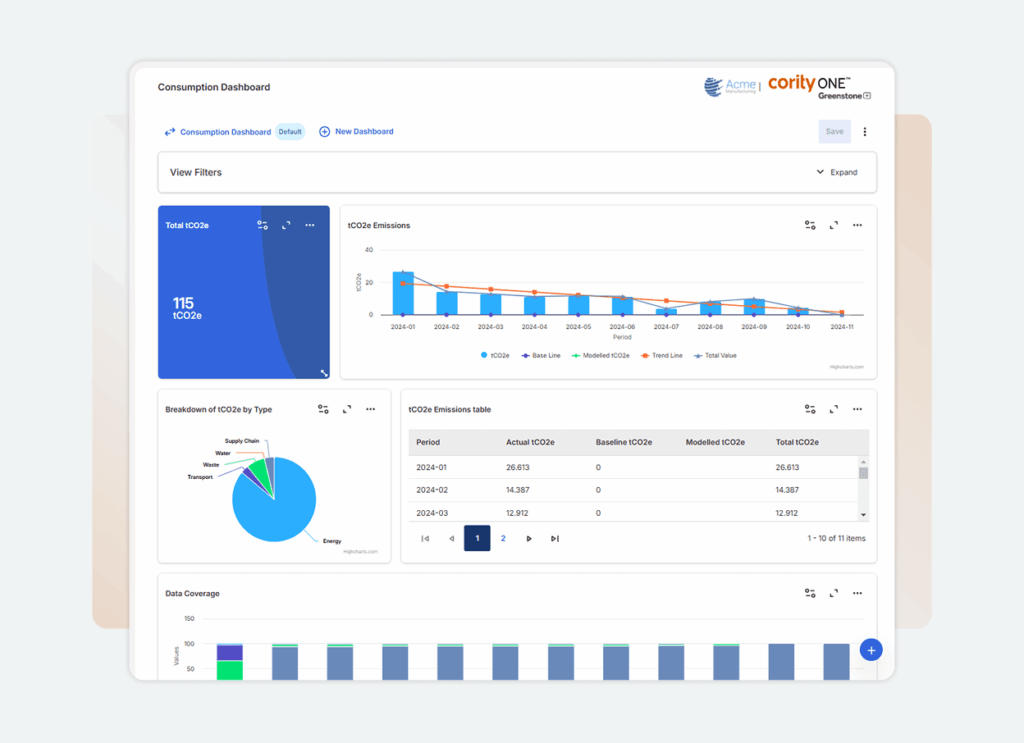
Real-time dashboards and shared workflows provide visibility across sites and programs, helping teams identify issues early, clarify ownership, and stay aligned from day-to-day operations through to sustainability reporting.
Cority’s converged EHS+ Sustainability platform, CorityOne, is powered by AI and built to break down silos between teams, harmonize operational and strategic efforts, and scale environmental and sustainability programs with confidence across the enterprise. Ready to explore?