


If you ask ten mining EHS leaders what’s wrong with their current systems, you’ll get ten different lists of symptoms. But beneath the symptoms, the same diagnosis keeps showing up: too many systems, too many spreadsheets, and too many places where people type the same data twice.
After 18 years of working alongside many mining organizations, I’ve seen that pattern repeat across operations of every size and in every global region. This piece covers the cost of running EHS across disconnected systems, what to look for in a single platform that can replace them and the regional differentiators that matter when building a business case.
The Hidden Cost of Fragmented Mine Safety Management Systems
Mining operations accumulate systems the way they accumulate equipment: one for groundwater monitoring, one for incident management, one for permits, consultants’ spreadsheets bolted on for emissions, and an occupational health program that has become a full-time data-entry role for someone hired to do something else entirely. Each one made sense when it was added. Together, they leave no single place to see what’s happening across a site, let alone across a portfolio of sites.
The cost rarely shows up in a single line item. It’s the clinician re-keying the same incident into two systems because they don’t connect. It’s the compliance team manually cross-referencing hundreds of permit conditions across sites because there’s nowhere to track them centrally. It’s the sustainability lead who can’t fully trust the database because people outside her team can edit it before it goes into an externally assured annual report. And the EHS manager hasn’t standardized anything across a multi-site operation because each site has chosen its own tools.
“Everybody sort of has their own different thing that they’re doing… I don’t think that’s a good idea. I think we need consistency with the EHS platform.”
— EHS lead, North American mining operation
Consolidating into a single platform that covers health, safety, environment, and sustainability is the most common goal mining companies are working toward. The question is what to look for when evaluating whether a platform can deliver it.
What to Look for in AI-Powered Mining EHS Software
AI has become a standard entry in every EHS vendor’s feature list, but many mining EHS leaders I talk to are skeptical of AI as a category. The relevant question isn’t whether a platform uses AI, but whether the AI does anything specific enough to change how work actually gets done.
The use cases that make a real difference in mining operations tend to be narrow and practical:
- AI that can scan an environmental permit and automatically extract compliance conditions removes hours of manual work and reduces the risk of something being missed across a portfolio of hundreds of permit conditions per site.
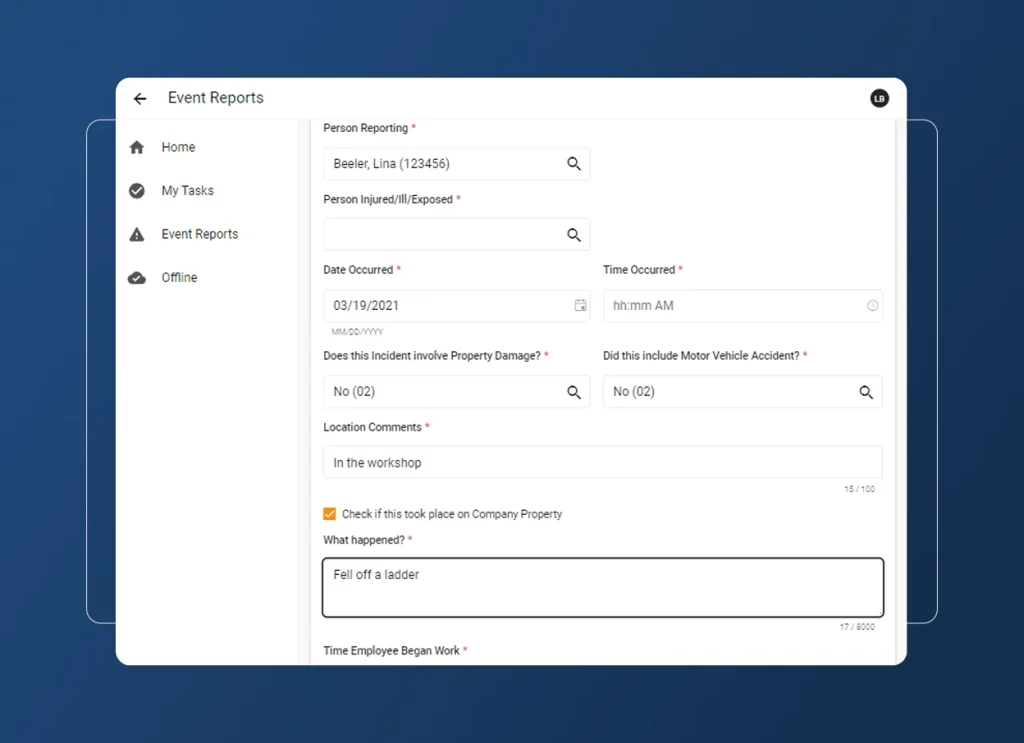
- AI that converts a photo of an incident scene into a pre-populated report form gets information into the system faster and more accurately than manual entry from the field.
- AI that supports post-accident investigation by surfacing relevant precedents and flagging gaps in documentation reduces the time specialists spend on procedural work and lets them focus on judgment calls that actually require their expertise.
A good way to evaluate AI capability is to see it working on your own material: one of your permits, one of your incident photos, one of your closed investigations. It’s also worth looking at where the output goes next. When extracted permit conditions sit alongside your inspections and compliance tasks, and an incident report flows straight into the investigation, the AI is reducing manual work across the whole process. Seeing a workflow end to end on your own documents gives you a clear picture of how it will fit into your operation.
Mining Compliance Management: A Multi-Framework Challenge
The compliance load in mining differs from most industries, not just in volume, but in the range of frameworks that apply simultaneously. A single site can manage occupational health surveillance requirements, environmental permit conditions, safety incident reporting obligations, and sustainability disclosure standards at once, each with different cadences, stakeholders, and consequences for getting it wrong.
In North America, MSHA and OSHA requirements anchor the safety and health side. Canadian operations add another layer of Indigenous consultation and land management, making it a standing obligation to track stakeholder interactions and overlay traditional territories onto operational footprints.
In EMEA, the compliance conversation increasingly runs through CSRD and European sustainability reporting requirements, often framed around the strategic importance of critical raw materials to European supply chains.
In APAC, Australian operations manage NPI and NGERS environmental reporting requirements alongside international standards (IFRS S1/S2, GRI, ISO), with an added dimension: data destined for externally assured annual reports needs a level of governance and edit control that many systems simply don’t provide.
Across all of these, the operational experience is the same. More obligations than any team can track manually, spread across more sites than any individual has visibility into. The right platform makes the compliance layer manageable, no matter which frameworks apply. But it must be configurable enough to handle different regulatory structures without requiring a custom implementation every time the regulatory environment shifts.
Offline and Remote Functionality: A Non-Negotiable for Mining EHS Software
A platform that works well in a corporate office doesn’t necessarily work on site, and what “on site” means differs significantly by region.
In North America, rotating shift patterns mean a significant portion of the workforce has limited or no regular computer access. Systems that assume daily logins or require desktop access for core functions create adoption problems before anyone can evaluate the software itself.
In EMEA, the constraint is more infrastructure-related: underground mining environments frequently have limited or no network connectivity, making offline functionality a baseline requirement rather than an optional feature.
In APAC, remote operations are the norm. Many sites also restrict mobile devices in operational areas or require intrinsically safe equipment, so hard-copy forms and offline data capture remain part of daily work even at operations with a sophisticated technology stack. Each paper form or offline record typed into a system later creates another point where data is delayed, duplicated, or lost. A platform built for these sites needs to capture data offline, sync it cleanly once a connection is available, and bring paper-based records into the same system without re-keying.
How Regional Risk Priorities Shape Mining EHS Software Requirements
Every mining operation uses its EHS platform to manage risk, but risk doesn’t look the same everywhere, and that shapes what the platform needs to prioritize.
In North America, risk management conversations often center on preventing critical incidents. Companies that have been through significant safety events discuss their technology decisions in that context, and the most important capability is identifying and acting on leading indicators before an incident occurs.
In EMEA, the risk in focus is more often investigative: the time and consistency cost of post-accident investigation is a live concern, and the best platforms support specialist judgment rather than trying to replace it. Speed and documentation quality matter, but the human interpretation of what happened and why remains the actual deliverable.
In APAC, for environmental and sustainability leads managing data that flows into externally assured annual reports, the primary risk is data integrity. A wrong number, or one that can’t be traced, is a material problem regardless of how well the safety program runs.
“I’m already having issues with the database being changed and edited. The control of our data management — especially for data that gets externally assured before it goes into annual reports — I need that control.”
— Environmental lead, APAC gold producer
Choosing the Right EHS Software for Mining: What Actually Matters
The case for consolidating EHS systems in mining holds wherever an operation sits. Every disconnected system adds re-keying, visibility gaps, and data that’s harder to trust. AI adds real value when it reduces specific manual work and its output stays connected to the rest of the process. Compliance obligations grow with every site and every framework. The regional layer matters too, because the right platform has to work underground, offline and on remote sites, and adapt to the regulatory frameworks each operation reports against. Mining EHS teams are best served by one platform with the depth to handle that full range, so their people spend less time managing systems and more time managing risk. Learn how CorityOne can help your teams turn complexity into strategic clarity.