
Article 29 LEC Reporting Made Easy: What You Need to Know
Enacted in 2021, Article 29 of the Energy Climate Law mandates an additional disclosure requirement for investors regarding sustainability information.


Enacted in 2021, Article 29 of the Energy Climate Law mandates an additional disclosure requirement for investors regarding sustainability information.
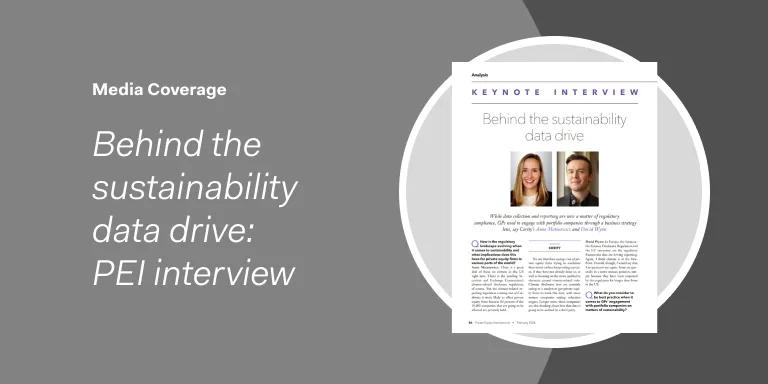
Cority’s Anne Matusewicz and David Wynn recently sat down with Private Equity International (PEI) to discuss data collection and reporting

In recent years, the private equity market has witnessed transformations driven by regulatory changes and shifting investor preferences. As a

2024 is set to be a pivotal year in the ever-evolving landscape of sustainability and environmental, social, and governance (ESG)

The Partnership for Carbon Accounting Financials (PCAF) is a worldwide collaboration of financial institutions that work together to develop and

In the ever-evolving landscape of sustainable finance, the European Green Taxonomy stands as a pivotal framework within the broader context

We’re delighted that Cority has been awarded ‘Best ESG Advisory / Consultant’ at the Private Equity Wire European Emerging Manager
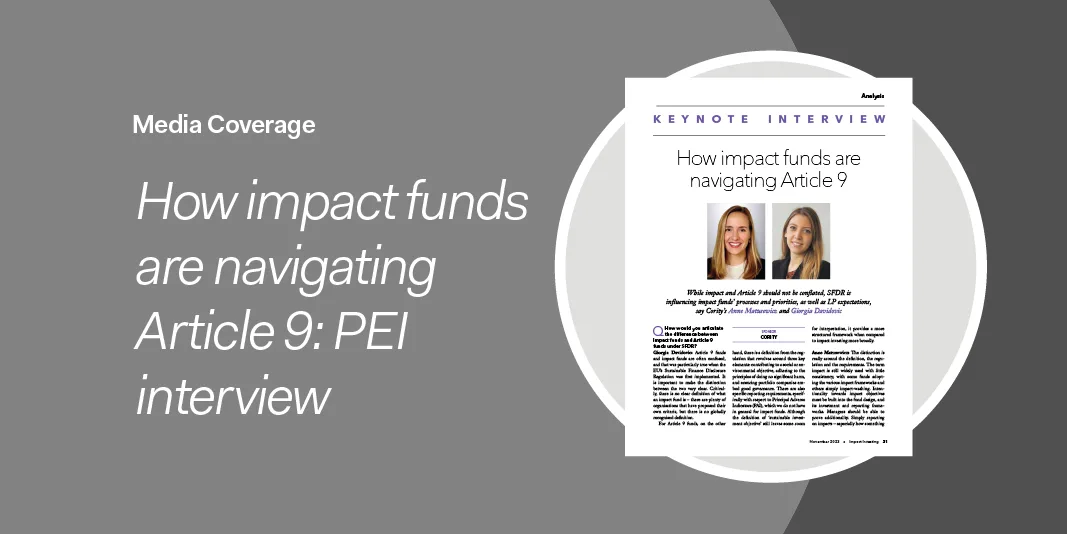
Cority’s Anne Matusewicz and Giorgia Davidovic recently sat down with Private Equity International to discuss impact funds and Article 9

It has been two years since the implementation of the SFDR (Sustainable Finance Disclosure Regulation) by the European Commission (EC).
Environmental, health, and safety (EHS) professionals are the protectors of their organizations. When they do their jobs well, they reduce