


In today’s environment of growing transparency expectations, manual, disconnected environmental and sustainability data processes simply cannot scale, leaving EHS teams trapped in a cycle of “data chasing” rather than data-driven decision-making. Integrating your environmental and sustainability data eliminates redundant workflows and slashes audit preparation time, allowing your team to focus on achieving decarbonization targets instead of just reporting progress toward them.
As we explored in our piece on connecting environmental and sustainability teams, sustainability and EHS operational teams often operate in parallel rather than together. The data gap between them is one of the biggest obstacles to credible, complete reporting.
This guide breaks down the path from fragmented inputs to a unified, audit-ready foundation, connecting sustainability, EHS, and operational teams that depend on the same underlying data.
Where environmental and sustainability data pain points come from
Most data challenges don’t come from a lack of effort. They come from the way environmental and sustainability data has historically been collected and managed across the organization.
Siloed workflows and inconsistent data
When teams work in silos, they often rely on overlapping data sets. One group may be using a digital platform while another tracks the same metrics in spreadsheets. This leads to duplicated work, inconsistent calculations, and conflicting numbers across reports. More importantly, it prevents organizations from seeing how operational performance connects to broader sustainability outcomes, and being able to make confident, quick, data-driven decisions.
Administrative burden and utility data
Obtaining accurate, repeatable environmental and sustainability data is still extremely manual for many organizations. Pulling invoices, converting units, chasing missing information, and re-entering data takes time and introduces risk. As reporting requirements grow in complexity, these manual processes simply don’t scale.
Utility data is a particularly common pain point. Bills arrive in different formats and languages, cover different time periods, and use inconsistent units and conversions, especially across multiple sites or regions. Manually standardizing this information before it can feed into reporting is both time-consuming and error-prone. And the same utility data typically needs to serve two purposes at once, for both environmental compliance reporting and ESG disclosure, which is making accuracy doubly important.
Audit risk and data traceability
When environmental and sustainability data is collected manually across multiple departments, e.g., facilities, procurement, HR, finance, or operations, it becomes difficult to trace where numbers came from and how they were calculated. During an audit, retrieving and reproducing that information accurately can be a significant challenge, increasing compliance risk and reducing confidence in reported results.
What connected environmental and sustainability data looks like
Connected data shifts organizations away from fragmented reporting toward a structured, reliable foundation that supports both compliance and performance management across EHS and sustainability functions.
A unified view of the environmental footprint
The challenge runs deeper than messy systems. A complete picture of any organization’s environmental footprint requires two very different types of data to come together: the operational, site-level data that environmental and EHS teams manage day-to-day, e.g., fuel combustion, energy consumption, waste, water, and the value chain emissions that sustainability teams are responsible for tracking upstream and downstream.
Connected environmental and sustainability data brings these two data sets together, operational site-level metrics alongside value chain emissions, to create a genuinely complete picture of an organization’s footprint. Instead of viewing emissions and impacts in isolation, organizations can begin to understand how activities across operations and the value chain contribute to overall performance and where the biggest opportunities for improvement lie.
A single source of truth
At the core of connected data is a single source of truth. This is often achieved through a shared data lake that aggregates inputs, metrics, and data from multiple systems and sources. By centralizing data, organizations eliminate duplicate entries, maintain clean and consistent structures, and ensure everyone is working from the same information.
Emissions data scattered across systems? There’s a better way. Strategic Emissions Management shows how leading organizations unify air, GHG, water, and waste data to reduce risk, meet evolving regulations, and turn environmental performance into a strategic advantage. Read the guide →
Connected data is standardized, traceable, and reproducible. This consistency improves accuracy and transparency, builds trust with internal and external stakeholders, and significantly reduces the effort required to respond to audits. For regulations such as the CSRD, which mandate third-party assurance, having accessible audit trails is no longer optional, it is essential.
Strong data governance
A connected data foundation also requires clear governance. This includes defined ownership, validation processes, and controls to ensure data quality over time. With proper governance in place, organizations can be confident that their data is reliable, defensible, and fit for decision-making.
How technology unifies environmental and sustainability data
Technology turns disconnected inputs into reliable, connected environmental and sustainability data. Integrated platforms automate data collection, reduce manual effort, and improve audit readiness. This creates a consistent foundation for reporting and decision-making across EHS and sustainability functions.
This shift is already visible in practice. Cority recently received two 2026 Environment + Energy Leader Awards for its AI-driven compliance and emissions innovation. Permit reviews that once took hours can now be completed in seconds, while emissions data that previously required external tools are now fully traceable and auditable within a single system. For organizations managing environmental and sustainability data at scale, this is quickly becoming the new benchmark.
Real-time monitoring through IoT devices automates the collection of emissions, energy, and water usage data, removing the need for manual data capture and reducing the risk of gaps or errors at source. AI-driven integrations can automatically extract and standardize data from utility providers and other external sources. And advanced analytics help both teams spot anomalies early, track performance against targets, and model decarbonization scenarios. For example, understanding how a capital equipment upgrade affects permit-level emissions and longer-term sustainability targets at the same time.
When the same platform serves both EHS compliance needs and sustainability reporting needs, with a shared data layer connecting them, the reconciliation problem disappears. Environmental and operational EHS teams can focus on operational details and permit compliance. Sustainability teams can model performance, set targets, and prepare disclosures. Both work from the same data, in the same system, with full audit trails that hold up under scrutiny.
See it in action
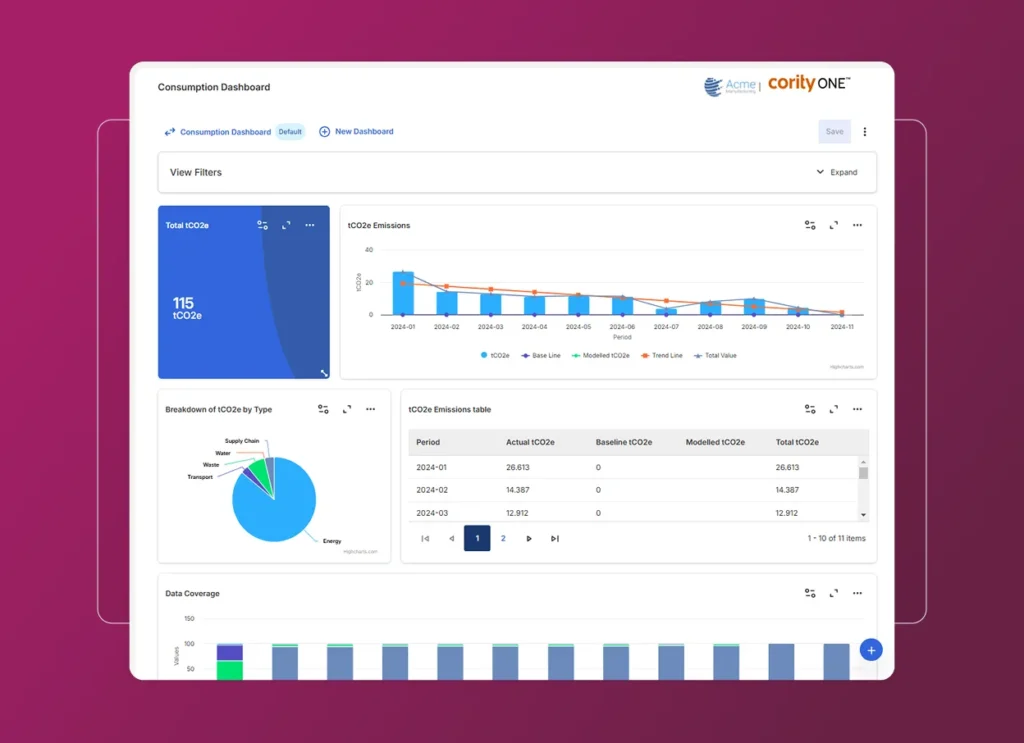
Cority’s converged EHS+ Sustainability platform, CorityOne, is powered by AI and built to unify operational and sustainability data in a single ecosystem, automating workflows, providing real-time visibility, and ensuring your organization has a reliable, audit-ready single source of truth. Learn how CorityOne can help your teams turn data complexity into strategic clarity.